Concrete Driveways, Slabs and Repair in Cedar Park

Twenty plus years of flatwork poured by our own crew, priced with the rock and the permits already accounted for.

Cedar Park Elite Concrete has spent 20+ years pouring driveways, slabs, patios, pool decks and sidewalks across Cedar Park, TX, and repairing the ones that were poured wrong the first time. We handle new flatwork, concrete leveling, stamped and decorative finishes, retaining walls and commercial work, and we pour our own jobs rather than handing them to whichever crew happens to be free that week. That continuity is the reason a quote from us survives contact with the ground.

Concrete is one of the few trades where the mistake is permanent. A driveway poured on uncompacted fill, a slab with its reinforcing lying on the dirt instead of sitting on chairs, a patio with no control joints cut in time — none of that shows on the day the forms come off, and all of it shows in year three. So we quote the parts of the job that decide whether it happens: the subgrade, the base, the reinforcing, the joint layout and the cure.

We also tell you what the city requires before you have to ask. Residential driveways and sidewalks are permit exempt in Cedar Park, the driveway approach is not, and where your lot sits over the Edwards Aquifer decides whether the state has to sign off before the city will issue a site development permit. Knowing which of those applies to your address changes the schedule more than anything we do with the concrete itself.

Get Your Free Quote

Fast response • No obligation

So we can reach you about your request.

So we can send you a confirmation after you submit this inquiry form.

  • 20+ Years Pouring Concrete
  • Registered & Insured
  • We Pour Our Own Jobs

What we do

Our Services

Concrete contractor serving Cedar Park and northwest Williamson County

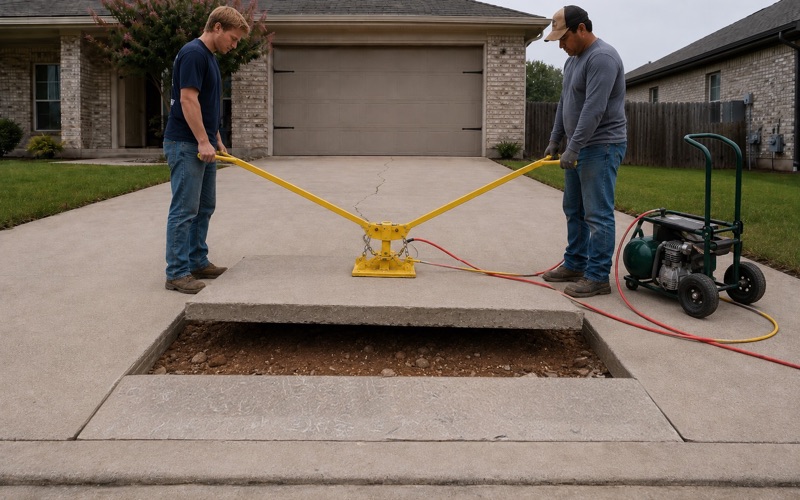
A failed section of concrete driveway in Cedar Park cut out on a straight saw line and being lifted clear, the four inch slab edge visible in section.

Concrete Repair

Driveway, patio, pool deck and parking lot concrete repair in Cedar Park, TX — diagnosed at the cause, not just patched.

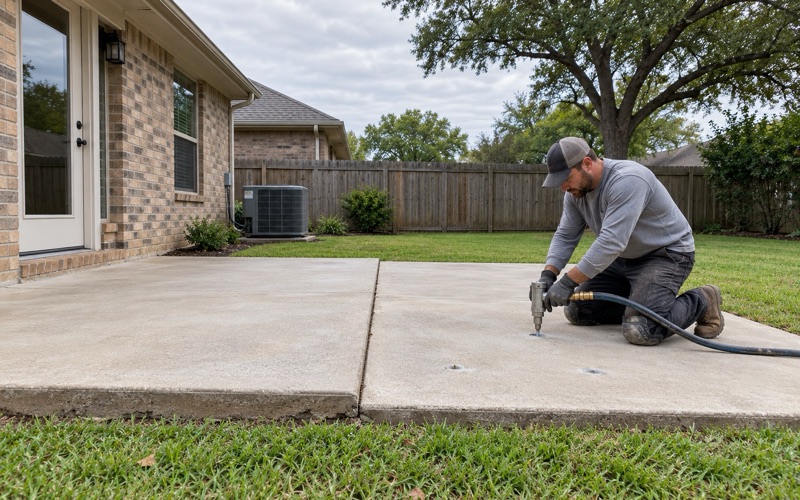
Polyurethane foam being injected through a drilled port to lift a settled concrete slab in Cedar Park, the hose running away off frame.

Concrete Leveling

We lift settled driveways, walks, patios and pool decks back to grade with polyurethane foam, and price the lift against replacement so you can compare.

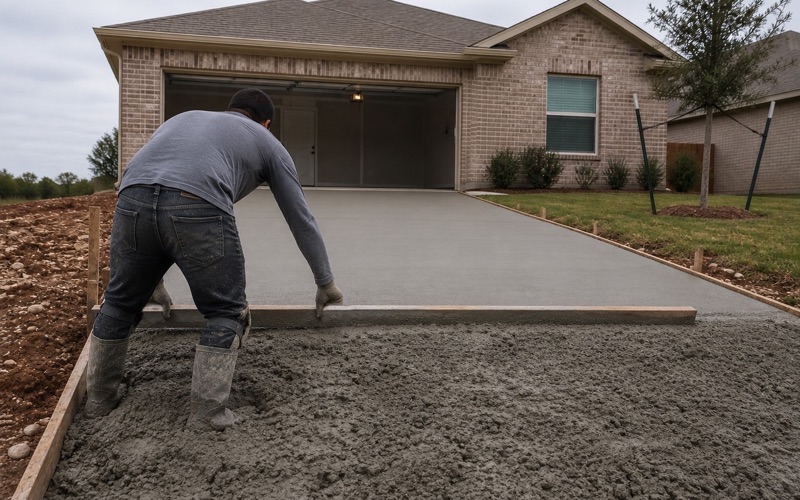
A screed board being drawn across a freshly placed concrete driveway in Cedar Park between two form boards.

Concrete Driveway

New concrete driveways and approaches, built to the city detail with the pre-pour inspection scheduled and the subgrade priced before we ever set a form.

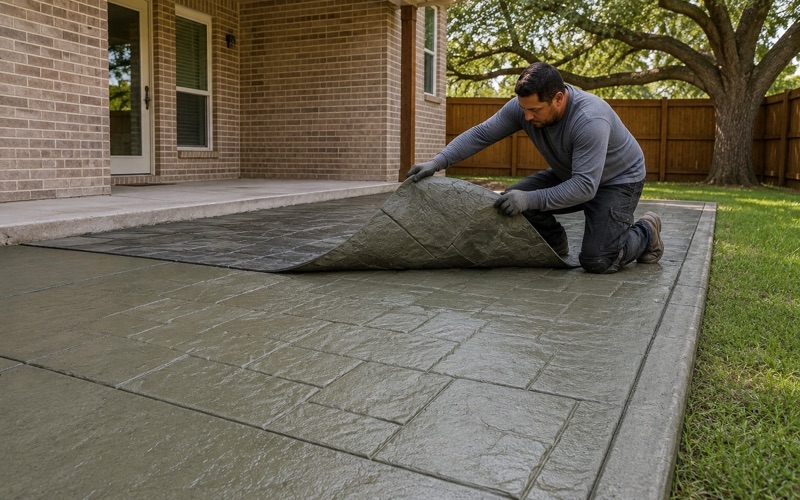
A stamp mat being peeled back off green colored concrete in Cedar Park, revealing the pattern beneath it.

Stamped Concrete

Stamped patios, pool decks and driveways — integral color, color hardener and stains, placed by the crew that quoted the job and sealed on a stated cycle.

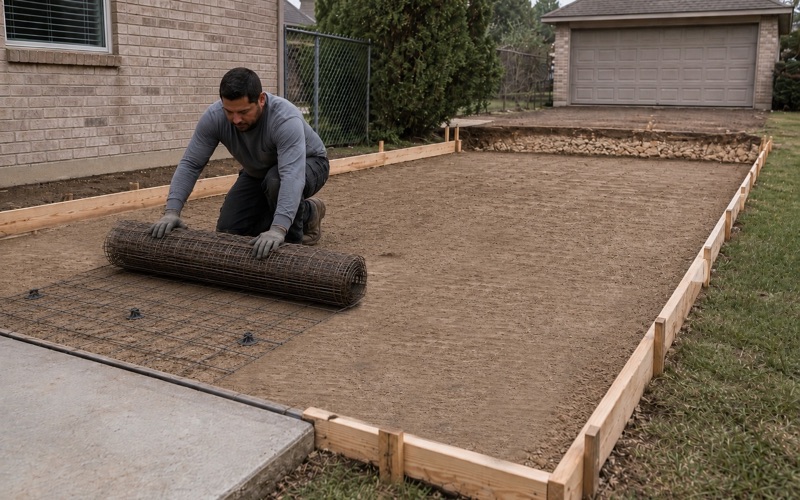
Welded wire mesh being rolled out on chairs over compacted base for a new concrete pad in Cedar Park, before any concrete.

Concrete Slab

Garage, shop, shed, RV and equipment pads, plus housekeeping, generator and transformer pads — built from the subgrade up rather than priced by the square foot.

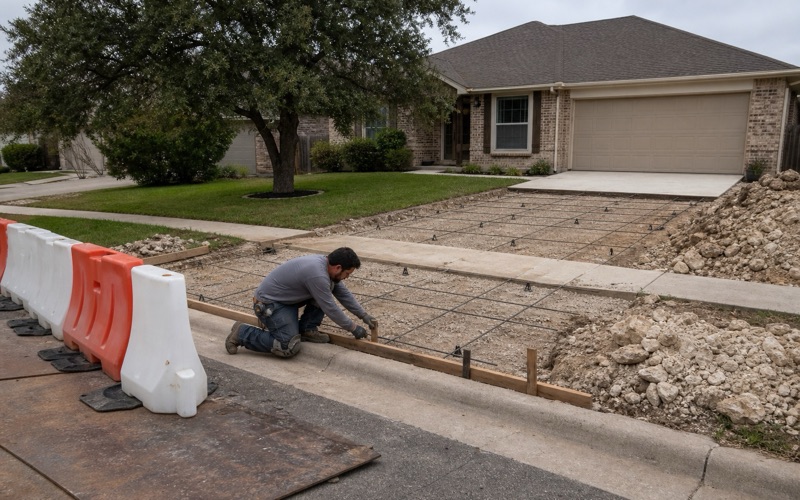
A drive approach being formed to the city detail in Cedar Park, the curb form set against the back of the existing curb and gutter.

Concrete Driveway Apron

The piece of your driveway that crosses public right-of-way, built to the city's published detail and inspected before any concrete goes down.

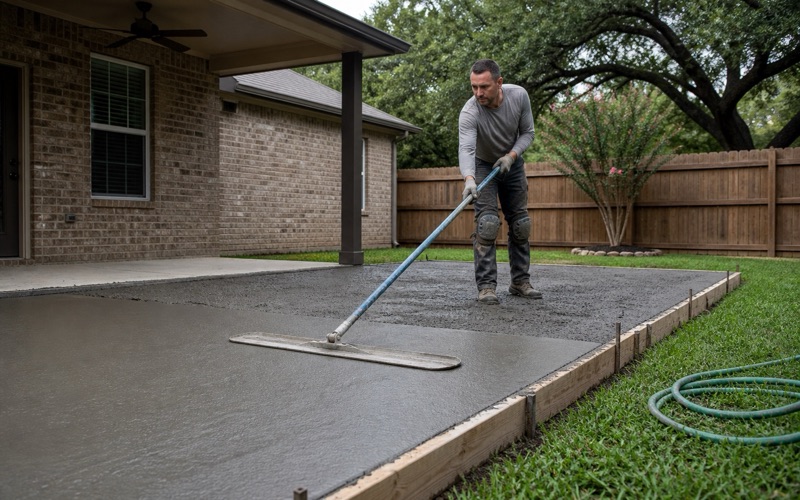
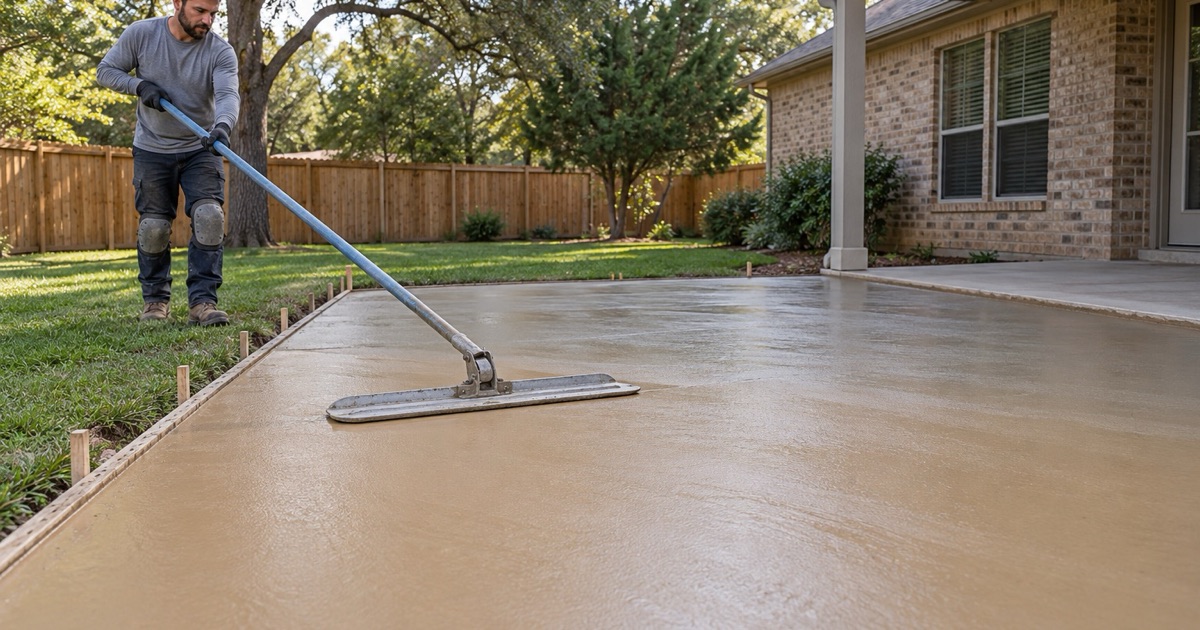
A bull float being drawn across a freshly placed concrete patio in Cedar Park, closing the surface before it sets.

Concrete Patio

Patios laid out around how the space actually gets used, drained away from the house, and isolated from the foundation so the two can move separately.

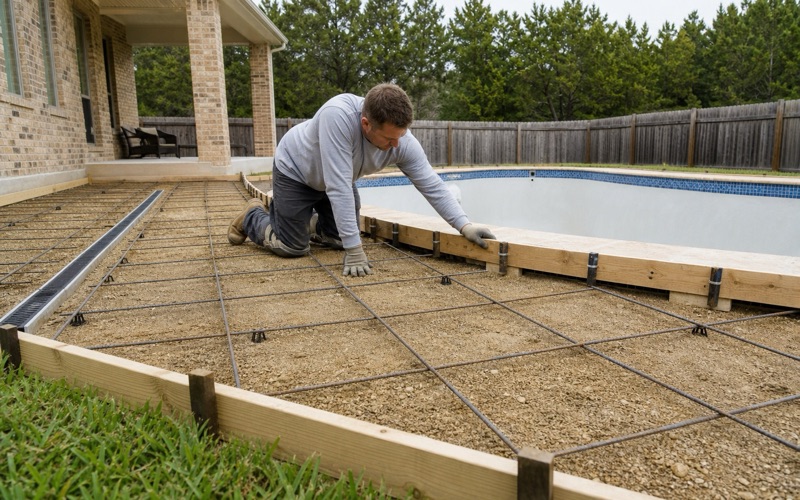
Cantilever coping forms being set around a pool shell in Cedar Park before the deck is poured.

Concrete Pool Deck

Pool decks built for bare feet in August — texture that grips when wet, a lighter surface that stays cooler, and joints that keep the deck off the shell.

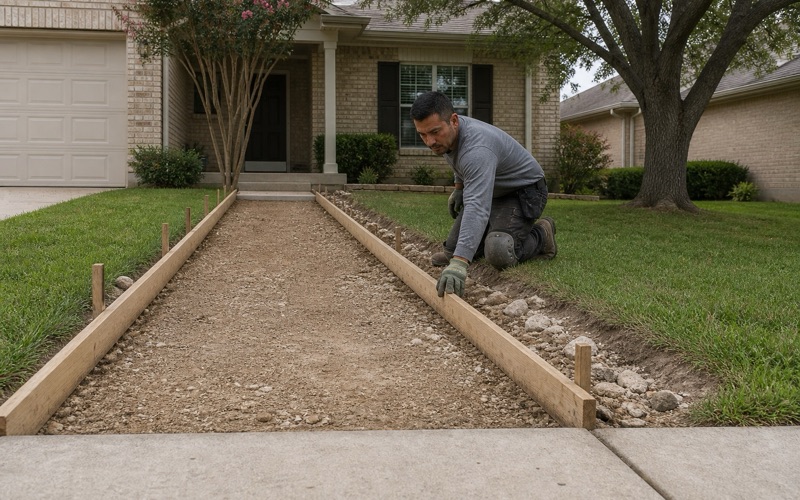
Forms being set for a new concrete walkway in Cedar Park, running from a porch landing to the city sidewalk.

Concrete Sidewalk

Sidewalks and garden walkways built to the accessibility standards that actually apply, with cross slope, ramps and warning surfaces done to the detail.

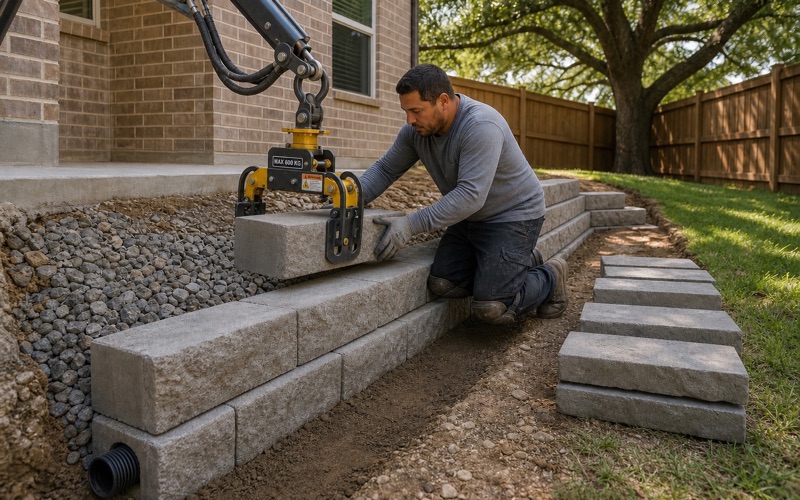
A segmental retaining wall going up course by course in Cedar Park, with drainage stone and pipe behind the first courses.

Concrete Retaining Wall

Cast-in-place retaining walls designed around what sits behind them — drainage, backfill and footing — because water is what actually takes a wall down.

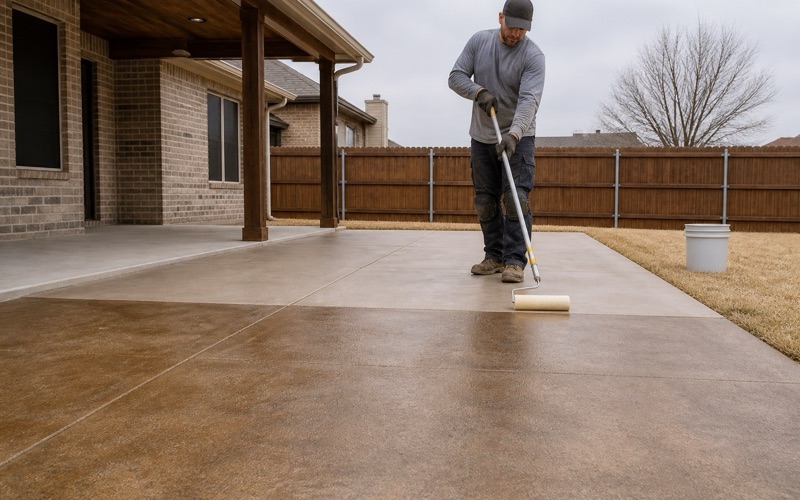
Sealer being rolled onto a cured decorative concrete patio in Cedar Park, the sealed half distinctly deeper in color than the dry half.

Decorative Concrete

Stains, overlays, polished floors and exposed aggregate — decorative work on new pours and on the sound slab you already have, chosen for how it ages.

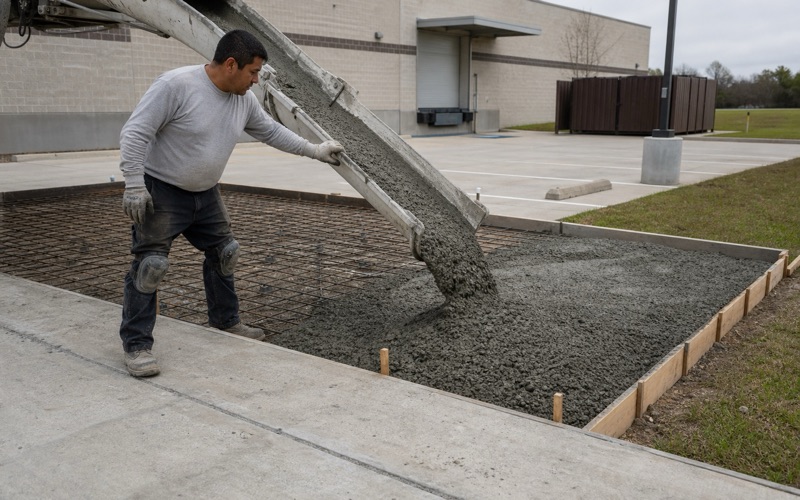
A ready mix chute being guided into a formed commercial slab in Cedar Park, the concrete building against the form.

Commercial Concrete Contractor

Commercial parking, ADA routes, dumpster and equipment pads, phased around a business that has to keep trading — with registration and fiscal security current.

What You Can Actually Check

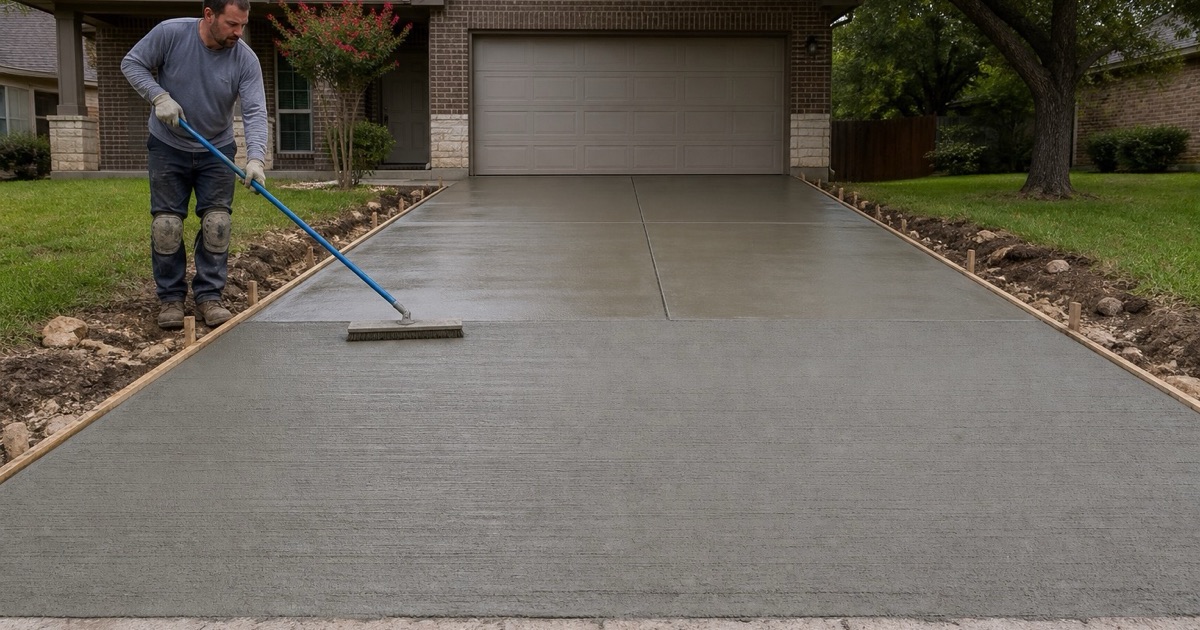
A broom finish being drawn across a new concrete driveway in Cedar Park, the textured half meeting the still smooth half in a clean line.

20+ Years Pouring Concrete

We have been placing flatwork in Cedar Park for more than 20 years, which is long enough to have gone back to slabs we poured and seen what held. Every job is poured by our own crew rather than subcontracted out, so the person who set the forms is the person who answers for them.

Registration and Fiscal Security

Texas issues no state license for a concrete contractor, so the credentials worth checking are the ones a city actually holds you to. Work in the right-of-way requires proof of fiscal security — a surety bond, letter of credit or cash deposit of $10,000 unless the Transportation Criteria Manual prescribes otherwise — and ours is current.

Insurance at the Right-of-Way Limits

The right-of-way ordinance sets minimum liability coverage before a permit issues: $100,000 for bodily injury or death of one person in any one accident, $300,000 for two or more persons, and $25,000 for property damage. We carry coverage at those limits and produce the certificate before work starts rather than after.

Why Choose Cedar Park Elite Concrete

Rock Priced Before the Pour

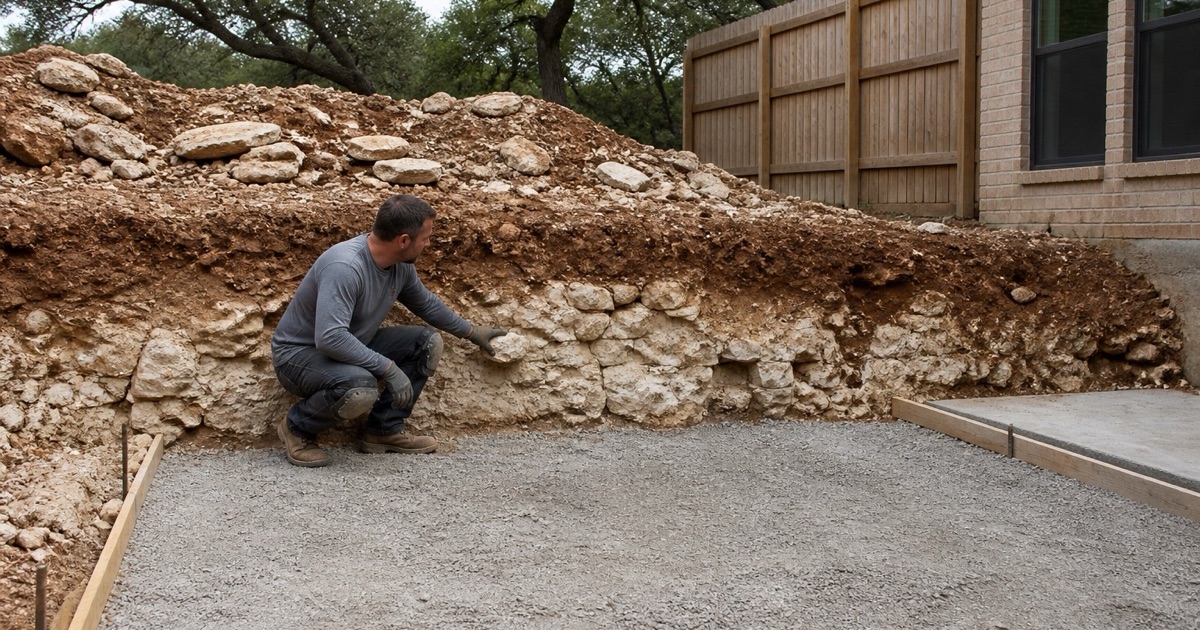
Every quote here starts with what the excavator is going to hit. Eckrant is the dominant soil across 45.5 percent of the city and carries indurated limestone at roughly 11 to 12 inches, so we probe before pricing and put rock excavation on the estimate rather than discovering it mid-dig and coming back to you for more money.

Pre-Pour Inspection Scheduled

No driveway approach of ours takes concrete before the city has looked at it. Cedar Park requires a Phase 1 inspection of line, grade, forms, reinforcing steel and subgrade on the approach, so we book it and wait for the inspector rather than pouring on our own schedule and hoping nobody asks afterward.

Aquifer Zone Checked First

We never quote new flatwork without checking where the lot sits. Most of Cedar Park lies over the Edwards Aquifer contributing zone and a smaller share over the recharge zone, and TCEQ approval has to come before the city issues a site development permit — so the zone gets checked at the estimate rather than at plan review.

Impervious Cover Measured

Adding a patio to a lot already near its cap is a permit problem, not a concrete problem. The state’s single-family test on the aquifer holds a lot to 20 percent impervious cover and counts rooftops, driveways, concrete pads, sheds and sidewalks toward it, so we measure what you have before drawing what you want.

Tendons Located Before Cutting

Every cut, core or anchor through a slab here gets located first. 86.0 percent of Cedar Park’s housing was built in 1990 or later and post-tensioned slab-on-ground is the norm on that stock, so we scan for unbonded single strand tendons before a blade touches concrete rather than finding one by cutting it.

New Concrete, and the Ground It Goes On

An open slab excavation in Cedar Park stopped on pale limestone about a foot down, with a worker holding a cobble of it against the cut face.

What a Concrete Driveway or Slab Job Involves

A flatwork job is several days of preparation and a few hours of concrete: layout, excavation, subgrade compaction, base, forms, reinforcing, the pour, the finish and the cure. We walk you through which stage your money is actually buying, because everything that decides whether the slab lasts is finished before the truck arrives.

Why the Subgrade Changes Within a Few Miles

Cedar Park straddles two soil survey areas and the ground shifts from shallow soil over limestone to deeper clay inside the city limits. Eckrant reaches rock within the first foot across more than two-fifths of the city, while the Georgetown series carries limestone at about 35 inches, so a price written for one address does not transfer to another.

Limestone Rock Excavation and Caliche

Where rock sits close to the surface, excavation stops being digging and becomes breaking. Rock outcrop is mapped as a named component over 1.8 percent of the city and the Eckrant-Rock outcrop association covers a further 4.1 percent, so we identify it at the estimate and price the hammer work instead of absorbing it as a change order.

Concrete Driveways and the Approach at the Curb

The slab on your property and the approach that crosses the right-of-way are two transactions with two rule sets. We build the private drive to your use and the approach to the city’s Type I detail, and we keep the finished drive inside the 70 percent of roadway frontage the code allows.

Slabs and Pads for Shops, RVs and Generators

Shop floors, shed pads, RV parking and equipment pads carry different loads and want different edge details. We size thickness and reinforcing to what will actually sit on the slab, because an RV pad built to patio thickness cracks under the first axle rather than after a decade.

Subgrade, Flexible Base and Vapor Retarder

What goes under concrete decides how it moves. We compact the subgrade, place flexible base where the ground calls for it, and set an ASTM E1745 vapor retarder under anything that will be enclosed or finished, so moisture does not come up through a floor covering a year later.

Welded Wire Reinforcement, Rebar and Fiber Mesh

Fiber mesh controls shrinkage cracking in the surface; rebar and welded wire reinforcement hold the slab together once a crack has formed. They do different jobs, so we tell you which yours needs and set steel on rebar chairs rather than laying it on the ground and pulling it up as the concrete goes in.

Post-Tensioned Slab-on-Ground

Most housing here sits on a post-tensioned slab, stressed by unbonded single strand tendons after the concrete cures. That changes everything about cutting into one, so any sawcut, core or anchor gets scanned and located first and we work to PTI DC10.1 practice rather than guessing at the tendon layout.

Summer Pours and the Discharge Clock

Hot weather work is governed by the temperature of the mix, not the reading on your porch. The state highway specification starts a 45-minute discharge clock once fresh concrete reaches 90 degrees, so we schedule summer pours early, order the mix to suit and keep the truck moving rather than losing a load on site.

When You Can Walk On It, Park On It and Seal It

Foot traffic is usually next day, vehicles wait considerably longer, and sealing waits longer still because the slab has to release moisture first. We give you those dates in writing with the proposal and apply a curing compound, so the concrete gains strength instead of drying out in the sun.

When Concrete Cracks, Sinks or Lifts

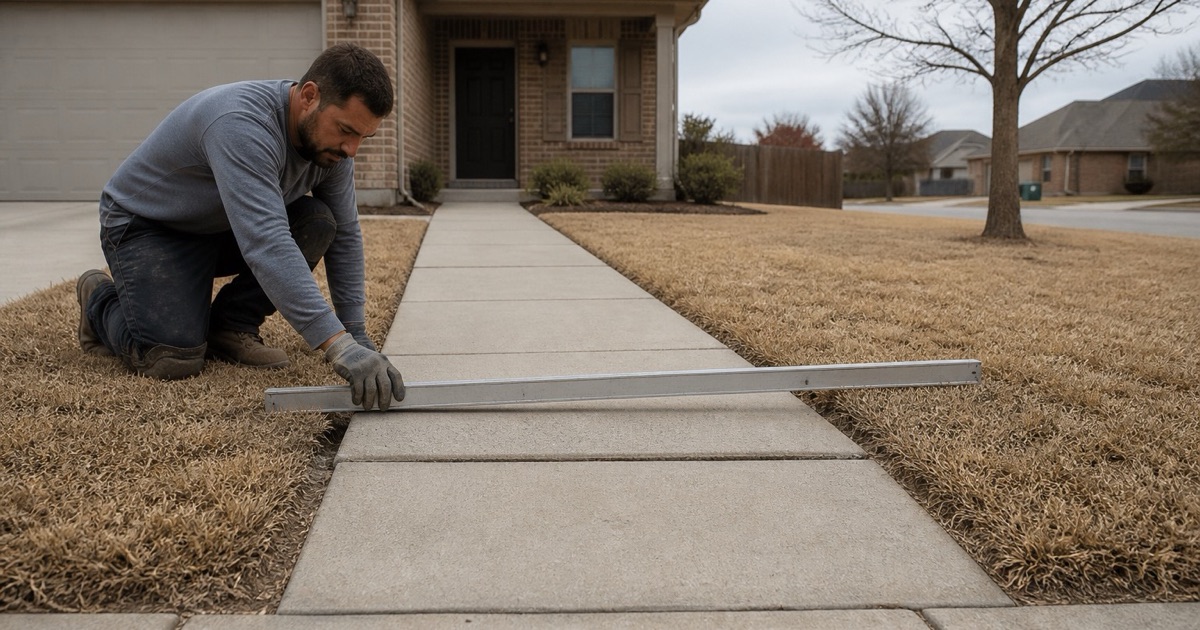
A settled concrete walkway panel in Cedar Park checked with a long straightedge laid across the low spot, the lip at the joint clearly visible.

Why New Concrete Cracks, and Which Cracks Matter

Concrete shrinks as it cures and it will crack somewhere; the whole job of a joint layout is deciding where. We cut control joints on time and at the right spacing, and we tell you plainly which cracks are cosmetic shrinkage and which mean the slab has lost support underneath it.

Settling Driveways and Sunken Patios

A slab sitting lower than it used to has not shrunk — the ground beneath it moved or washed out. We probe to find the void before pricing anything, because the visible drop is only the symptom and the cavity underneath is the thing that actually has to be solved.

Concrete Leveling with Polyurethane Foam Injection

Polyurethane foam injection lifts a slab through small ports and cures within minutes, where older mudjacking pumps a heavy slurry through much larger holes. Foam weighs a fraction of that slurry, which matters on ground that already failed to hold what was there, so it is what we use for most residential slabjacking.

Why Patching Over a Void Does Not Hold

Filling the crack while leaving the cavity under the slab gives you a repaired surface sitting on nothing. The slab keeps moving and the patch opens again within a season, so we fill the void first and treat the surface repair as the last step rather than the only one.

The Gap Between the Driveway and the Garage Slab

That joint is an isolation joint doing its job — the driveway and the house foundation are separate structures and are meant to move independently. We reseal it with a flexible sealant over backer rod so water stays out of the subgrade, rather than packing it with rigid material that cracks straight back out.

Trip Hazards and Diamond Grinding

Where two sidewalk panels have offset, diamond grinding takes the lip down to a flush transition in an afternoon for a fraction of replacement. Few contractors offer it because the ticket is small, so we quote it alongside partial-depth and full-depth repair and let you see the difference for yourself.

Cracks Inside a Builder’s Warranty Window

A new-build slab that has cracked may still be the builder’s responsibility, and making a warranty claim costs you nothing. We will tell you what we see and what it usually means before you spend money with us, because paying us for work a warranty already covers is a bad trade for you.

Concrete Repair Against Replacement, Priced Honestly

Lifting and repairing a slab that is still structurally sound costs a fraction of tearing it out and pouring again. We quote both with real numbers on the same page and say which one your concrete actually needs, because the expensive answer is not automatically the correct one.

Resurfacing, Overlays and Microtopping

A microtopping or overlay resurfaces a slab whose surface has worn or spalled but whose structure is intact. It is a genuine option on sound concrete and a waste of money on broken concrete, so we check the condition of what is underneath before recommending it to anybody.

When a Utility Cuts Your Driveway or the Street

Utility work that cuts a drive or the pavement in front of it leaves a restoration obligation behind it. We handle the concrete side of that restoration and match the existing section, and we tell you where responsibility sits before you pay for something the utility owes you.

Patios, Pool Decks and Decorative Concrete

Color hardener being broadcast by hand across a freshly floated patio slab in Cedar Park, the treated half distinctly warmer than the untreated half.

Stamped Concrete Against Pavers

Stamped concrete gives you pattern and color in one monolithic pour with no joints for weeds to find; pavers can be lifted and reset individually but settle unevenly over time. We price both honestly and point out that stamped work depends far more on the finisher’s skill than on the stamp itself.

Choosing Color for Full Texas Sun

Color on an exterior slab in full sun drifts toward the lighter end over years, and dark integral color runs hot underfoot. We steer you toward a mid-tone integral color with a release agent for depth, so the surface ages evenly instead of showing every wear path as it lightens.

Pool Deck Finishes You Can Stand On in August

Surface temperature is the deciding factor on a pool deck and it is set mostly by color. We keep pool decks light, favor a broom or salt finish that breaks up the surface, and we say no to dark integral color on a deck people cross barefoot in August.

Slip Resistance and the Texture Trade-Off

Texture buys grip and costs you cleaning — a heavy broom finish holds dirt in the grooves, while a hard trowel finish cleans easily and turns slick the moment it is wet. We match texture to location: aggressive around water, moderate on a patio, smooth only where it stays dry and covered.

Matching New Concrete to an Existing Patio

New concrete does not match old concrete on day one, and no contractor can make it. Cement color varies between batches and the existing slab carries years of weathering, so we say up front that the two converge over a season rather than promising you an invisible seam.

Banding and Borders on a Large Pour

On a large slab placed in more than one pour, a shade difference between sections is likely. We design a band or border along that joint so the difference reads as an intentional line rather than a mismatch, which turns an unavoidable problem into part of the layout.

Exposed Aggregate, Broom, Salt and Trowel Finishes

Exposed aggregate washes the surface paste back to reveal the stone, a broom finish drags texture across fresh concrete, a salt finish presses and dissolves rock salt for a pitted surface, and a trowel finish closes it smooth. Each has its place, and we tell you which suits the traffic your slab will take.

Acid Stain, Water-Based Stain and Integral Color

Acid stain reacts chemically with the slab for a variegated, permanent result; water-based stain gives more predictable color across a wider range; integral color is mixed into the truck and runs all the way through. Outdoors we lean on integral color with stain as an accent, because what sits only on the surface wears where you walk.

Sealing, Densifiers and the Three-to-Five-Year Question

A penetrating sealer soaks in and repels water without leaving a film that can peel or cloud, and a densifier hardens the surface itself. Most exterior slabs want resealing every three to five years depending on exposure, and we tell you what yours actually looks like instead of selling you a schedule.

Widening a Driveway Built for Two Cars

Older drives were sized for narrower vehicles and fewer of them. Widening means matching thickness and reinforcing to the existing slab, tying in or isolating at the seam, and confirming the finished width stays inside the 70 percent of roadway frontage the code permits.

Approaches, Permits and Commercial Work

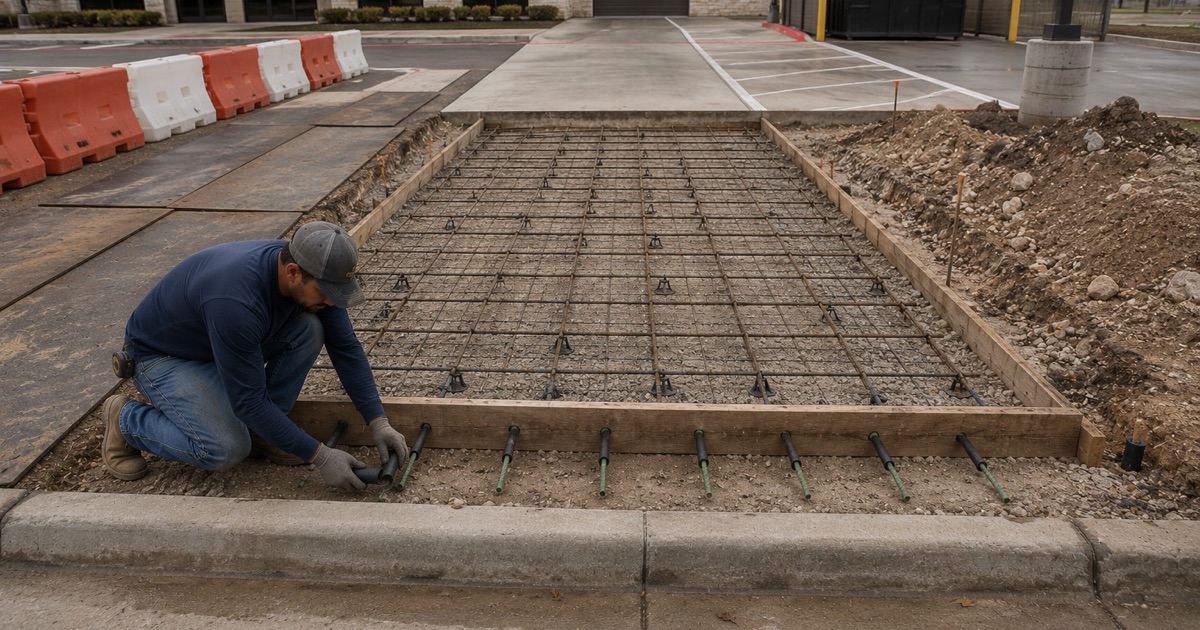
Dowels being set through a header board at a commercial drive approach in Cedar Park, formed square to the curb and gutter before the pour.

Whether Your Flatwork Needs a Cedar Park Permit

Residential driveways and sidewalks are permit exempt here — the city’s fee schedule prices a flatwork permit at $35 and writes the single-family exclusion into the fee line itself. We tell you that at the estimate rather than billing you for a permit the city does not require.

The Driveway Approach, RD-02 and the Phase 1 Inspection

The approach is the exception, because it crosses into public right-of-way. It carries a mandatory Phase 1 pre-pour inspection of line, grade, forms, reinforcing steel and subgrade, and because Cedar Park publishes no plain driveway detail we build to RD-02 or RD-03 as drawn — both of which show a shared use path.

Working Over the Edwards Aquifer

Sampling the city against the state’s Edwards Aquifer layer returns 81.9 percent contributing zone and 6.0 percent recharge zone, so most addresses here carry a state review. Under an approved plan the contractor owes TCEQ written notice 48 hours before construction begins and must report any void larger than 6 inches encountered on site.

Parking Lot Repair and the Accessible Route

Commercial lots fail in patches long before they fail as a whole, and the accessible route through them is the first thing an inspector looks at. We phase repair so that route stays usable, and we bring the path of travel up to standard when the section it crosses is being replaced anyway.

Curb Ramps, Truncated Domes and PROWAG

A curb ramp needs a detectable warning surface of truncated domes at the flush transition, with slope, landing and width all inside tolerance. We build to PROWAG and the Texas Accessibility Standards and check finished slopes with a level, because a ramp that misses by a fraction of a degree fails inspection.

Wheel Stops, Bollards and What Fails First

The small concrete in a lot fails first: wheel stops break loose from their pins, bollards get hit and loosen at the base, and pad edges spall where trucks turn. We replace and reset those as their own scope, because they are cheap to fix and expensive to leave alone.

Dumpster Pads and Where the Requirement Lives

A dumpster enclosure pad takes point loads from a truck that most flatwork never sees, and the requirement for one usually sits in the zoning or development code rather than the building code. We build the pad thick enough for the lift and tell you which section is actually driving it.

Generator, Transformer and Housekeeping Pads

Equipment pads are dimension-critical work: anchor bolt patterns, conduit stub-ups and level tolerance all have to match the equipment before it arrives. We set them from the manufacturer’s drawing and use a housekeeping pad detail where the unit sits indoors, so the installer is not chipping concrete on delivery day.

Street Cuts and the Pavement Moratorium

Cedar Park restricts cutting a recently paved street: a stretch of at least 300 feet resurfaced with one and a half inches or more of asphalt counts as a new street for seven years on a collector or arterial and five years on a residential street or alley. We check pavement age before you plan a cut.

When a City, a MUD and an Association All Sign

An address here can answer to the city, one of three municipal utility districts and a homeowners association at once — the city’s own HOA layer carries 87 neighborhood records covering 29,490 homes. We find out who signs before the schedule depends on it, rather than after a stop-work notice.

Areas We Serve

Cedar Park Elite Concrete provides concrete-contractor throughout the greater Cedar Park area, with the same crews and the same standards on every job.

Good to know

Frequently Asked Questions

What decides the price of a concrete driveway in Cedar Park?

Square footage is the smallest part of it. Excavation is what moves a price here, because where limestone sits close to the surface the dig becomes breaking work, and after that it is thickness, reinforcing, truck access and whether the job includes the approach across the right-of-way. We put those on the estimate as separate lines so you can see what you are paying for.

Do I need a permit for a new driveway, patio or sidewalk?

For residential flatwork on private property, no — the city's own fee schedule excludes single-family from the flatwork permit. The exception is the driveway approach, which crosses into public right-of-way and carries a mandatory Phase 1 inspection of line, grade, forms, reinforcing steel and subgrade before any concrete is placed. We schedule that inspection and wait for it.

Is a concrete contractor licensed in Texas?

Texas issues no state license for concrete work, which is why the word licensed on a contractor's website often means nothing you can check. What you can verify is city registration and the fiscal security the right-of-way ordinance requires — a surety bond, letter of credit or cash deposit of $10,000 — plus liability insurance at the ordinance limits. Ask any bidder for all three.

How soon can I drive on a new concrete driveway?

Foot traffic is generally fine the next day. Vehicles wait considerably longer while the slab gains compressive strength, and heavy vehicles longer again. We give you the specific dates with the proposal and apply a curing compound, because concrete that dries too fast in Texas sun finishes weaker at the surface than the mix design intended.

Should I level my slab or replace it?

If the concrete is sound and has simply lost support underneath, leveling costs a fraction of replacement and is usually finished in a day. If the slab is broken through, spalled across the surface, or has lost reinforcing to corrosion, lifting it only buys you a level version of the same problem. We quote both and tell you which one yours is.

Rebar or fiber mesh — which does my slab need?

They solve different problems. Fiber mesh reduces shrinkage cracking while the concrete cures; rebar and welded wire reinforcement carry load and hold the slab together after a crack forms. Most driveways and structural pads want steel on chairs, with fiber as an addition rather than a substitute. Fiber alone on a driveway saves the contractor money and solves nothing.

How long does a job take from first call to finished concrete?

A straightforward residential pour is a few days of work spread across a couple of weeks, because the schedule is driven by inspections, ready-mix availability and cure time rather than by labor hours. Jobs touching the right-of-way, or needing state review over the aquifer, run longer. We tell you which category yours falls into at the quote.

Will new concrete match my existing patio or driveway?

Not on the day it is poured, and any contractor promising otherwise is setting you up to be disappointed. Cement color varies between batches and your existing slab carries years of weathering on it. The two move closer over a season or two, and where an exact match matters we design a banded joint so the transition reads as intentional.

Do I have to seal my concrete?

You do not have to, but a penetrating sealer slows water and stain absorption and helps a decorative finish hold its color. Exterior slabs here typically want it renewed every three to five years depending on sun and traffic. We use penetrating products rather than film-forming ones outdoors, because a film that fails peels and clouds instead of simply wearing away.

What happens if you hit rock during excavation?

We work hard not to be surprised by it. Eckrant, the dominant soil across a large share of Cedar Park, carries indurated limestone at roughly 11 to 12 inches, so rock is expected here rather than exceptional and we probe before quoting. Where it is present the estimate carries a rock excavation line from the start, not a change order later.

Ready to Get Started?

Request a free quote today and we'll get back to you fast.