Cedar Park Elite Concrete builds concrete driveway aprons in Cedar Park, TX and has done for more than 20 years, serving surrounding cities including Brushy Creek, Leander, Hudson Bend, Round Rock and Wells Branch. The apron is the short piece where your driveway crosses into public right-of-way and meets the street, and it is the one part of a driveway job with a rulebook attached.
Everything on your side of the line is straightforward — this city leaves residential driveways and sidewalks permit exempt, and we say so rather than adding a permit line to the invoice. The apron is the exception, and it is where jobs go sideways when a crew treats it as more of the same concrete.
We schedule the inspection the city requires and we wait for it. That sentence is the whole difference between an apron that is finished and an apron that is merely poured. It is not a demanding standard to meet. It only asks that the pour be planned around somebody else’s calendar instead of ours, which is a scheduling habit rather than a skill.
What an Apron Actually Has To Do
Where Private Concrete Ends and the Right-of-Way Begins
The property line and the visible edge of the pavement are rarely the same place, and the apron spans between them. Establishing where the right-of-way actually starts is the first thing we do, because it decides which portion is inspected, what detail governs it, and where the joint between the two pours belongs.
Owners are often surprised by how far the right-of-way reaches back from the curb. It is commonly wider than the paved street plus the walk, which means a good deal of what looks like front yard is public. We locate the line from the plat rather than from the fence, because guessing it wrong puts the joint in the wrong place and the inspection over the wrong concrete.
Grade, Transition and the Gutter Line
An apron has to carry a vehicle from street grade up to your driveway without scraping and without damming the gutter. Those two goals pull against each other, and the resolution is in the transition rather than in the slope of either end. Water has to keep running along the gutter line after the apron is in, which is the test a surprising number of existing aprons fail.
We check the finished profile with an actual straightedge before the pour, in the places a low car will find first. A driveway that scrapes on entry is not a defect the concrete will grow out of, and correcting it afterward means breaking out the apron and starting again. Long wheelbase vehicles and low front ends find a bad transition immediately, and they find it every single time they enter.
Where a Sidewalk or Shared Use Path Crosses
Where a walk crosses the approach, the walk’s requirements come with it: a cross slope that stays within limits, a surface that meets PROWAG and the Texas Accessibility Standards, and a detectable warning surface with truncated domes where one is called for. We build those in rather than pouring an apron and cutting the walk in afterward.
Building to the City’s Published Detail
RD-02, RD-03 and the Shared Use Path
Cedar Park publishes no plain driveway detail, so we build the crossing to RD-02 or RD-03 as drawn, both of which show a shared use path. Working from a published detail rather than an interpretation of one turns the inspection into a formality — the inspector is checking the same drawing we built from.
The Phase One Pre-Pour Inspection
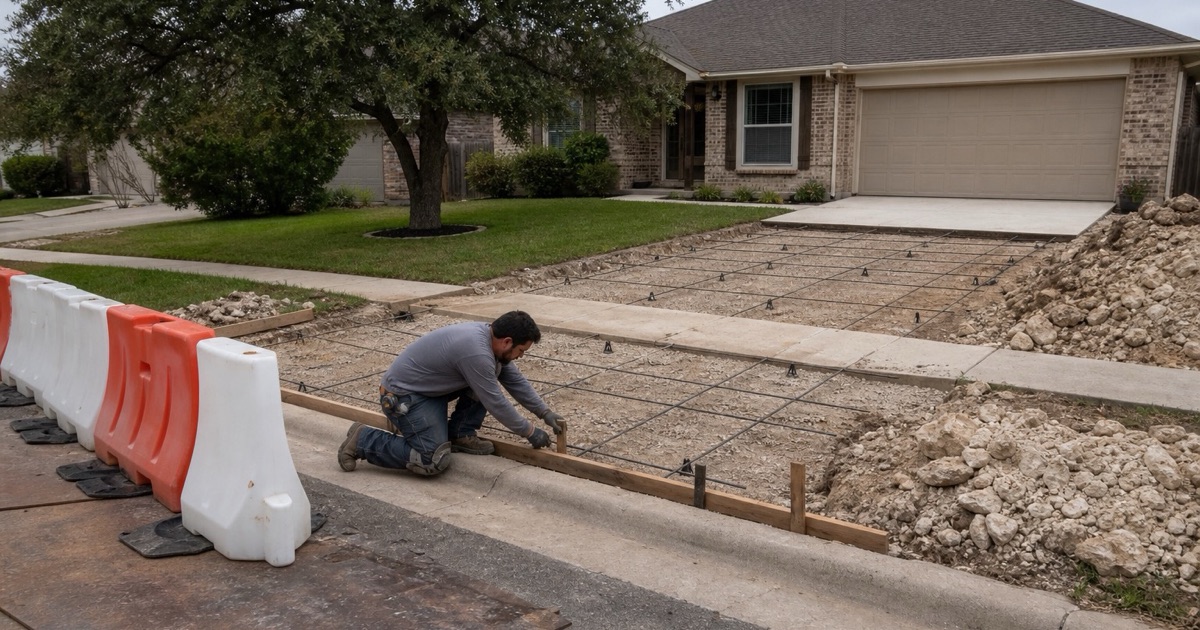
The city inspects the line, grade, forms, reinforcing steel and subgrade before any concrete goes down. We book it, we build to be ready for it, and the forms sit until it has happened. It costs a slot in the schedule and nothing else, and skipping it is how an owner ends up with unapproved concrete in the public right-of-way.
Building to be ready for the inspection is most of the work. The forms have to be true, the reinforcing steel set and tied at height, the subgrade compacted and the line and grade established — all of it visible and none of it buried. An inspector arriving to find any of that half-done costs a second visit and a day.
The Criteria Manual That Actually Applies
We work from the transportation criteria manual Cedar Park adopted in June 2026, not the City of Austin manual it replaced. Crews still building from the old book are building to a standard nobody is inspecting against any more, and the details are not identical. Where the two documents differ, it is generally in dimensions and details rather than in principle, which is exactly the kind of difference a crew working from memory will not notice until the inspector does.
Tie-Ins, Backfill and What Happens Afterward
Doweling Into Existing Pavement
Where new concrete meets old, we dowel the joint so load transfers across it. A butted joint with nothing through it opens, and then the edges spall under every wheel that crosses. This is the least visible part of an apron and the part that decides how it looks in five years.
Doing it properly means drilling the existing concrete on line and on level rather than driving bars in at whatever angle the hole came out. It is slow, unglamorous work that nobody sees, and it is the single thing most likely to be skipped by a crew pricing to be lowest.
Flowable Backfill and Erosion Control
Trench and edge backfill along an approach settles if it is placed loose, and settled backfill takes the apron edge down with it. Flowable backfill solves that where compaction access is poor. Erosion and sedimentation control goes in while the ground is open, because the disturbed area drains straight to the street.
Street Cuts and the Moratorium
If the work needs the pavement opened rather than just the apron rebuilt, the street may still be inside the city moratorium — seven years on a collector or arterial, five on a residential street. We tell you that before you plan around a cut, not after the application comes back refused.
Where a cut genuinely cannot be avoided, the restoration standard for opening a recently resurfaced street is higher than for an older one, and that changes the number. Knowing which side of the moratorium your street sits on before you commit to a plan is worth an afternoon of checking.
- 20+ Years Pouring Concrete
- Registered & Insured
- We Pour Our Own Jobs