
Cedar Park Elite Concrete pours concrete sidewalks and walkways in Cedar Park, TX and has done for more than 20 years, serving surrounding cities including Brushy Creek, Leander, Hudson Bend, Round Rock and Wells Branch. Walks look like the simplest concrete on a property, and they carry the most rules of any of it.
Some of that is accessibility law, which applies to public walks and to a great deal of commercial frontage. The rest is ordinary use: a walk is the one surface people cross in the dark, carrying things, at every age. A trip hazard on it is a different class of defect from a crack in a patio.
Because the concrete quantity is small, the price differences between quotes come from preparation and from whether anyone measured anything. That is worth knowing before comparing two numbers that look far apart. Two quotes for the same walk can differ by more than the concrete itself costs, and the gap is almost always excavation, base, and whether anybody put an instrument on the finished grade.
Residential Walkways
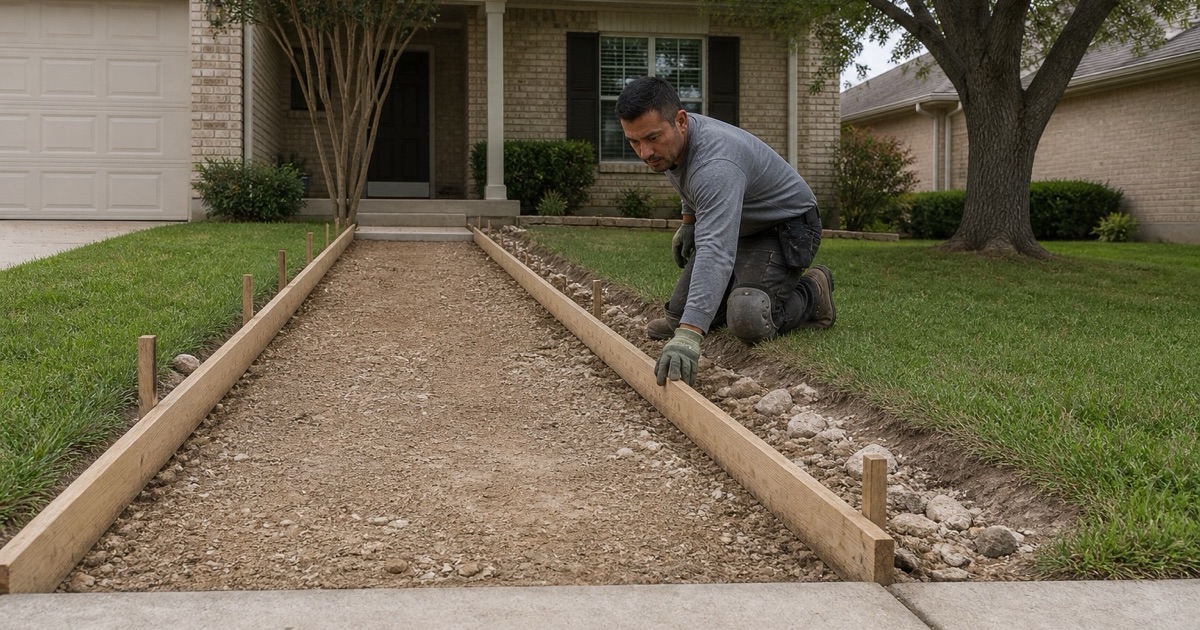
Entry Walks and Front Approaches
The walk from the drive to the front door sets the first impression of a house and takes the most traffic of any path on the property. We size it for two people abreast, keep the fall away from the entry so water is not delivered to the threshold, and lay out joints that suit the run rather than falling wherever the crew stopped.
Where the walk meets steps or a porch, an isolation joint keeps the two free of each other. Walks poured tight against a porch slab are a reliable source of cracked corners. The same goes for a walk running alongside a foundation: it gets its own joint rather than being cast against the house, so seasonal movement has somewhere to go.
Garden Paths, Side Yards and Utility Routes
Side yard runs are the paths that get built too narrow and then get walked around. They also carry the mower, the trash cans and everything else that has to get to the back, so they earn a bit more width and a bit more thickness than a purely decorative path.
Surfaces That Behave in the Damp
Shaded walks along the north side of a house stay damp and grow a film, so texture matters more there than anywhere else on a property. A broom finish across the run and a grit in any sealer is cheap insurance, and it is awkward and expensive to add after somebody has already slipped.
Public Walks, Frontage and Accessibility
Cross Slope, Running Slope and Width
A public walk has to meet limits on cross slope, running slope and clear width, and the cross slope limit in particular is tighter than instinct suggests. We set and check those with instruments rather than by eye, because a walk that looks fine and measures out of tolerance is a walk that gets rebuilt at somebody’s expense.
We also check them before pouring rather than after. Once concrete is down, a slope that misses by a small margin is not adjustable — it is a demolition. Forming to a measured grade costs one extra pass with an instrument and avoids the only mistake on a walk that cannot be corrected once it has cured.
Curb Ramps and Detectable Warning Surfaces
Where a walk meets a vehicle way, a curb ramp brings the grades together and a detectable warning surface with truncated domes gives a tactile cue at the transition. PROWAG and the Texas Accessibility Standards govern the geometry, the placement and the contrast, and the domes are specified rather than chosen. We build ramps to the published detail and confirm the layout before the pour.
Walks That Cross a Driveway Approach
Where a walk crosses an approach it enters public right-of-way, and the rules of that space come with it. Cedar Park publishes no plain driveway detail, so the crossing gets built to RD-02 or RD-03 as drawn — both of which show a shared use path — and the right-of-way portion is inspected before any concrete goes down. We book that inspection and wait for it.
Repairing Walks Instead of Replacing Them
Grinding Out a Trip Hazard
Where one panel stands proud of the next and both are sound, diamond grinding takes the lip off in an afternoon. There is no drilling, no new concrete and no cure to wait through, and on a public walk it brings the change in level back inside what the standards allow. It is the cheapest good answer available and it is frequently not offered.
Lifting a Settled Panel
Where a panel has dropped because of a void underneath, grinding treats the symptom. Lifting the panel back to grade restores the line and, unlike grinding, it does not thin the slab. We look under the concrete before recommending either, because the two failures look identical from above.
Partial-Depth Repair, Full-Depth Repair and Joint Resealing
Spalling at a joint or a corner break is usually a partial-depth repair rather than a panel replacement. Where the concrete has broken through, full-depth repair of the affected panel is the honest fix. Either way the joints get cleaned and resealed afterward, which is what keeps water out of the thing we just repaired.
Knowing which of these four a walk needs is most of the value we add on a repair call. Quoting all of them as replacement is the easy way to a bigger invoice, and it is not what we do. We would rather come back for a grinding job in two years than replace a run of sound concrete today.
- 20+ Years Pouring Concrete
- Registered & Insured
- We Pour Our Own Jobs