
Cedar Park Elite Concrete builds concrete retaining walls in Cedar Park, TX and has for more than 20 years, serving surrounding cities including Brushy Creek, Leander, Hudson Bend, Round Rock and Wells Branch. A retaining wall is the only concrete on a property that spends its whole life being pushed, so almost everything that decides whether one survives is behind it rather than on the face.
That is not how walls get sold. The face is what you look at and what appears in the quote, and the drainage, backfill and footing that keep it standing are invisible by the time the job is finished. It is also where the corners get cut, because nobody can see what was left out.
There is a local wrinkle as well. Ground here changes from deep clay to rock close enough to the surface that excavation becomes the job, so two walls of identical height on lots a mile apart are genuinely different projects. We find out which one yours is before we price it.
What Actually Holds a Wall Up
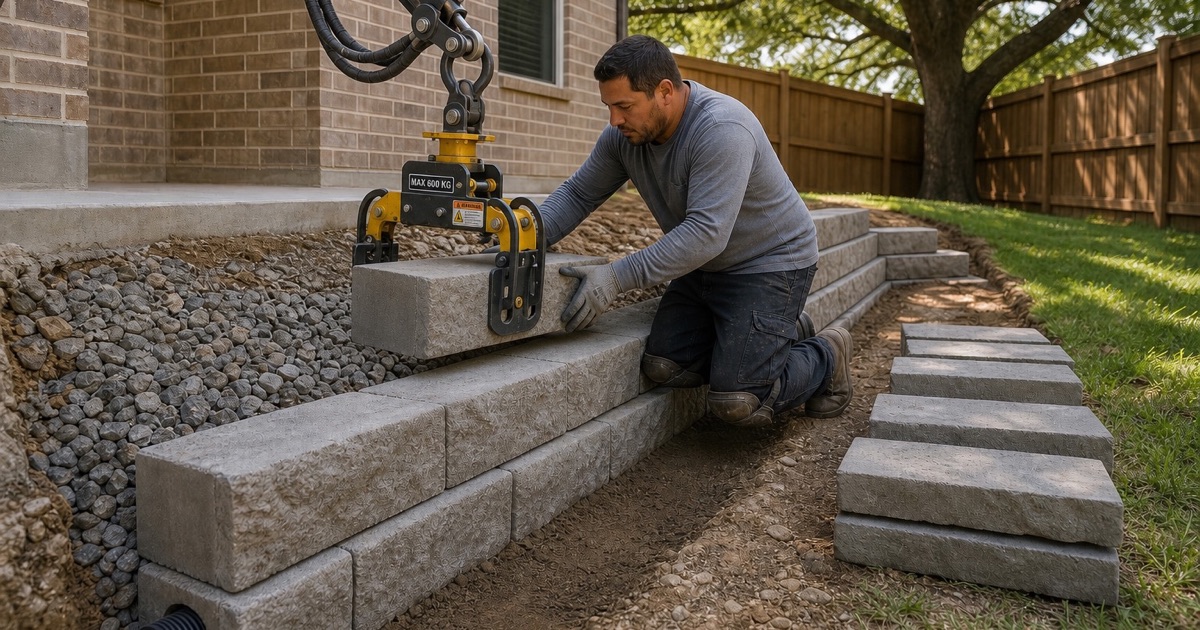
The Footing and What It Sits On
A retaining wall works as a lever, and the footing is the fulcrum. It gets sized for the height, the soil and anything loading the ground above, then placed on material that will not move — which on the clay side of the county means getting below the zone that swells and shrinks with the seasons.
Where rock comes up near the surface the footing can often bear directly, and the cost moves from earthwork into excavation. Neither situation is a problem. Discovering which one applies after the quote is signed is the problem.
Reinforcement and Cast-in-Place Construction
Cast-in-place walls are reinforced continuously from the footing up through the stem, so the wall and its base act as one piece. Bar size, spacing and the lap into the footing come from the design rather than from habit, and steel gets tied and chaired at the right cover so it is protected by concrete rather than sitting near the surface rusting.
Drainage Behind the Wall
This is the part that matters most and is easiest to leave out. Saturated soil weighs far more than dry soil and pushes far harder, so a wall without working drainage is being asked to hold back a load nobody designed it for. Drain rock, a filter to stop it silting up, a collector at the base and somewhere for the water to actually go are all one system, and it fails if any part is missing.
Weep holes through the face are the visible half and the least important half. What decides whether they ever run is the material behind them.
Design Decisions Worth Making Early
Surcharge: What Sits Above the Wall
A driveway, a patio, a pool or a slope above a wall all load it, and they change the design rather than just the height. A wall built for open ground above and then handed a parking area is a wall being used outside its design. Tell us what is going up there, including what you might do later.
Terracing Versus One Tall Wall
Two lower walls stepped back are frequently better than one tall one — smaller footings, less reinforcement, easier drainage and, on many lots, a better use of the space. They also stay clear of the height at which engineering and permitting requirements tighten. We will run the comparison rather than defaulting to whichever is easier to build.
Cast-in-Place, Block and Where Each Belongs
Poured concrete gives a monolithic wall with no joints for water to exploit, and it is what we reach for on taller walls and anywhere the wall is doing real structural work. Segmental block is faster and often more attractive on a low garden wall. The honest answer is that both have a range, and the mistake is using block where the geometry has moved past it.
Finishing, Drainage Detail and the Ground Around It
Faces, Forms and Finish
Form choice sets the finish, and a wall can be left with a clean form finish, board-formed for texture, or given an integral color so the color is through the concrete rather than on it. What we avoid is anything that traps water against the face, since a wall is wet on one side by definition.
Erosion Control While the Ground Is Open
Cutting into a slope leaves bare soil above a street or a neighbor, so erosion and sedimentation control goes in as the excavation starts rather than after the first rain moves the site downhill. It is a small line in a quote and a large problem when omitted.
Backfill, Compaction and Settlement
Backfill goes in in lifts and gets compacted as it goes, with flowable backfill where access makes proper compaction impossible. Backfill dumped in one go settles, and settlement behind a wall shows up as a sunken strip, then as water finding the gap, then as pressure the wall was never meant to carry.
- 20+ Years Pouring Concrete
- Registered & Insured
- We Pour Our Own Jobs