
Cedar Park Elite Concrete works as a commercial concrete contractor in Cedar Park, TX and has for more than 20 years, serving surrounding cities including Brushy Creek, Leander, Hudson Bend, Round Rock and Wells Branch. Commercial work differs from residential less in the concrete than in everything wrapped around it — access, phasing, accessibility law, inspections and the fact that your business has to keep operating while we are on site.
That is where most of the risk on a commercial job actually sits. The pour is a known quantity; the parking spaces you cannot lose during a Saturday, the accessible route that has to stay open, and the inspection that has to happen before concrete goes into right-of-way are the things that decide whether a schedule holds.
One thing worth settling early, because it comes up in every bid conversation: Texas issues no state license for a concrete contractor. What you can genuinely check is city registration and the fiscal security the right-of-way ordinance requires, and ours are current.
Commercial Flatwork and Site Concrete
Parking Areas, Drive Aisles and Fire Lanes
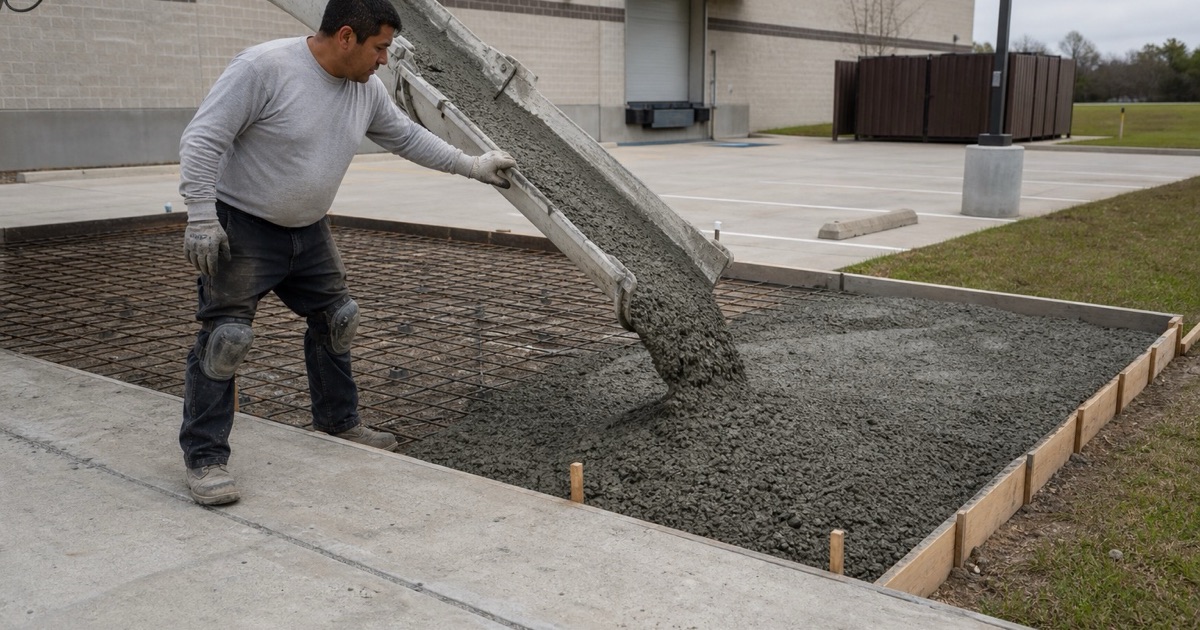
Parking concrete is designed around turning loads and the vehicles that will actually use it, which on a site with deliveries or a fire lane means something quite different from passenger cars. Slab thickness, jointing and load transfer at joints all follow from that, and getting the joint layout right is what keeps the edges from breaking down under repeated turning.
Dumpster Enclosure Pads and Service Yards
A dumpster pad is the hardest-worked concrete on most commercial sites. The collection truck lands in the same place every week and turns on the same spot, so the pad and its approach get built as one slab, reinforced for the loading, rather than as a pad with an apron tacked on. Service yards get the same treatment where forklifts or pallet jacks are in play.
Housekeeping, Generator and Transformer Pads
Equipment pads are dictated by the equipment rather than by us. Anchor bolt patterns, conduit stub-ups, grounding and clearances come from the manufacturer’s drawing and the utility, and a pad poured before that layout is confirmed becomes a demolition job rather than an adjustment. We build from the approved drawing and check the setout before the pour.
Accessibility, Right-of-Way and Inspections
Accessible Routes, Curb Ramps and Detectable Warnings
The accessible route is a legal requirement running from the parking space to the door, and every element on it has tolerances: space and aisle slopes, curb ramp geometry, cross slope along the walk, and a detectable warning surface with truncated domes where the route crosses a vehicle way. PROWAG and the Texas Accessibility Standards govern the detail, and we form to measured grades and verify them before concrete rather than after.
That order matters more here than anywhere else on a commercial site. A slope that misses by a small margin is not adjustable once cured, and the remedy is demolition of the element and a second pour.
Wheel Stops, Bollards and Protection
Bollards protect the things that cost real money to replace — storefronts, gas meters, equipment and the corners of buildings — and they only work if their foundations are sized for an impact rather than set like fence posts. Wheel stops get anchored properly and placed so they do not become the trip hazard on somebody’s accessible route.
Right-of-Way Work and the Pre-Pour Inspection
Anything crossing into public right-of-way is inspected before concrete goes down: line, grade, forms, reinforcing steel and subgrade. We book that inspection, build to be ready for it, and leave the forms standing until it has happened. Cedar Park publishes no plain driveway detail, so commercial approaches get built to RD-02 or RD-03 as drawn, and we work from the transportation criteria manual the city adopted in June 2026.
Working Around an Operating Business
Phasing, Access and Trading Hours
We phase commercial work so that parking, deliveries and the accessible route stay usable through the job, and we sequence pours around your hours rather than our convenience. Night and early-morning pours are ordinary on retail and restaurant sites. The phasing plan is part of the quote, so what closes and when is agreed before anyone arrives.
Environmental Controls and the Aquifer
Erosion and sedimentation control goes in while the ground is open, because a disturbed commercial site drains straight to the street. Where the site sits over the Edwards Aquifer recharge or contributing zone, a TCEQ water pollution abatement plan and state approval have to precede the city’s site development permit — a sequence that belongs in the project schedule from the first week.
Curing, Hot Weather and Turning the Site Over
Commercial pours are large enough that curing discipline shows up directly in the finished floor, so curing compound and protection are planned rather than improvised. Summer work is scheduled around the temperature of the concrete rather than the air, since the state highway spec starts the discharge clock once the mix reaches ninety degrees, which in practice means early starts and short hauls.
- 20+ Years Pouring Concrete
- Registered & Insured
- We Pour Our Own Jobs