
Cedar Park Elite Concrete does decorative concrete in Cedar Park, TX and has for more than 20 years, serving surrounding cities including Brushy Creek, Leander, Hudson Bend, Round Rock and Wells Branch. Decorative work covers everything from a stain on a slab you already own to color and texture chosen before the truck is batched, and the two routes have very different economics.
The most useful thing we can tell most people is that the slab under their feet is often worth keeping. A sound existing slab can be stained, overlaid or polished for a fraction of what replacing it costs, and the result is a genuinely new floor rather than a compromise. What decides it is the condition of the concrete, not its age.
Where the concrete is new, the decorative decisions happen early — some of them at the batch plant — so they belong in the first conversation rather than after the forms are up. We will also tell you which options look superb in a showroom and age badly in full Texas sun.
Decorative Work on Concrete You Already Have
Acid Stain and Water-Based Stain
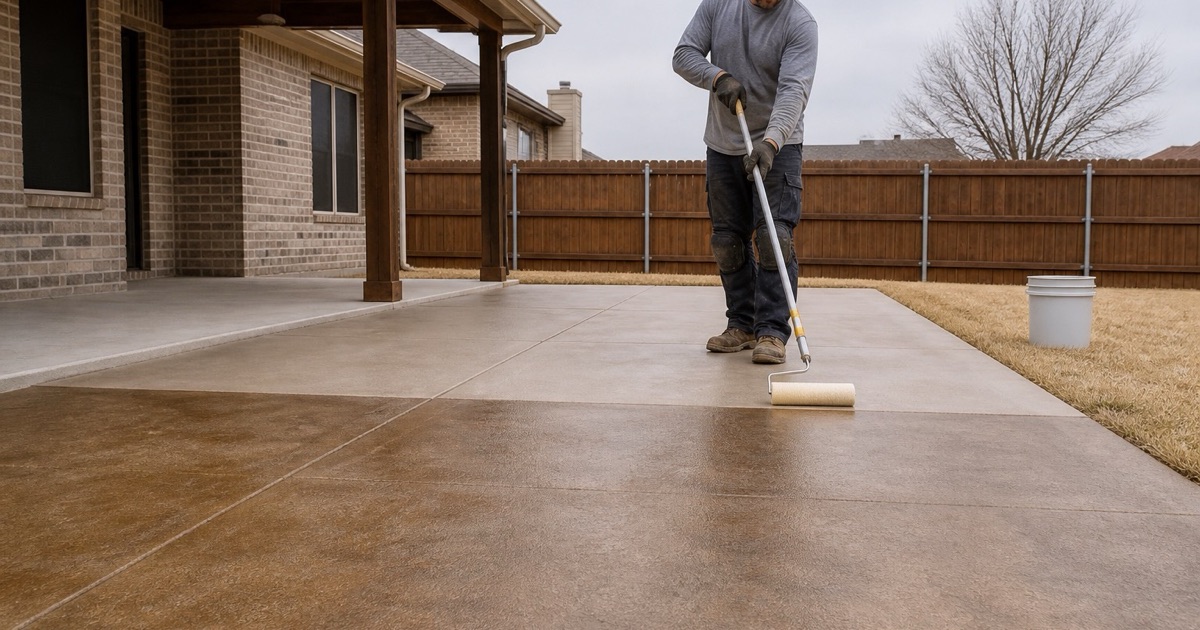
Acid stain reacts with the concrete itself, producing depth and variegation that no two slabs give up in the same way. Water-based stains open up colors that acid chemistry cannot reach and behave far more predictably, which matters when you are matching something. Neither hides a poor surface, and both read differently on a twenty-year-old slab than on one poured last month, so we sample on your concrete rather than showing you a chart.
Overlays and Microtoppings
An overlay or a microtopping is a new wearing surface bonded to the slab you have. It is the route to a fresh, uniform finish over concrete that is structurally fine but cosmetically finished, and it can be colored, textured or patterned as part of the work. What it cannot do is bridge movement — an overlay follows its slab, so anything actively cracking or settling gets dealt with first.
Grinding, Polishing and Densifiers
Grinding and polishing turns a slab into its own finished floor, with a densifier hardening the surface so it resists dusting and wear without a coating on top. How much aggregate the grind exposes is a design decision made in the first pass, and it is not reversible. On garage, shop and interior floors it is frequently the best long-term value of anything on this page.
Decorative Choices in a New Pour
Integral Color and Color Hardener
Integral color is batched into the concrete so the color runs through the slab, which is what makes it the most durable choice outdoors — a chip exposes more of the same color rather than gray. Color hardener is worked into the fresh surface instead, coloring and densifying the wearing layer. They are different tools with different failure modes, and we will explain which one your project actually wants.
Exposed Aggregate and Salt Finish
Exposed aggregate puts the stone on show and is among the most durable decorative finishes there is, which is why it survives on driveways and pool surrounds that would wear a topical treatment out. A salt finish gives lighter texture and a softer look. Both grip well when wet, which is the practical reason they persist here rather than a stylistic one.
Sawcut Patterns, Borders and Bands
Some of the most effective decorative concrete is restrained. A plain field with a stained or exposed aggregate border, or a sawcut pattern that turns necessary control joints into a deliberate grid, reads as designed and costs far less than treating the whole area. It also wears better, because the plain field is doing the work traffic actually asks for.
Living With a Decorative Surface in Central Texas
Sun, Sealers and the Reseal Cycle
Ultraviolet is what ages these surfaces, and the sealer is the sacrificial layer that takes it. Film-forming sealers give the rich, wet look people usually want from stained concrete and need recoating sooner; penetrating sealers change appearance least and last longest. We name the product and the interval, because a decorative surface that never gets resealed is a decorative surface with an end date.
Indoor Versus Outdoor Choices
Indoors, the constraints are wear and cleaning, which is where polished floors and microtoppings do their best work. Outdoors, everything is arbitrated by sun and water, and the finishes that survive are the ones with color through the material or texture in the surface. Moving a product from one context to the other is the most common way a decorative floor disappoints.
Repair, Patching and Matching Later
Decorative surfaces can be repaired, and they cannot be made invisible. New color starts its weathering clock the day it goes down while the surrounding surface is years along. Where we know a repair is coming, we plan the seam to land on a control joint or a change of plane so the eye reads it as part of the layout.
- 20+ Years Pouring Concrete
- Registered & Insured
- We Pour Our Own Jobs