
Cedar Park Elite Concrete has handled concrete repair in Cedar Park, TX for more than 20 years, serving surrounding cities including Brushy Creek, Leander, Hudson Bend, Round Rock and Wells Branch. We repair driveways, patios, walkways, pool decks, parking lots and equipment pads — and we start by working out why the concrete failed, because a repair that ignores the cause is a repair you pay for twice.
Most failed flatwork around here failed from underneath. The ground in this part of Williamson County runs shallow over indurated limestone in much of the city and deep clay elsewhere, so one slab settles into a washed-out void while another two miles away cracks over rigid bearing on rock. Those two problems look identical from the driveway and take opposite repairs, which is why we probe before we price.
The other thing we check before touching a slab is what is inside it. 86.0 percent of Cedar Park’s housing was built in 1990 or later, and post-tensioned slab-on-ground is the norm on that stock, so every sawcut, core or anchor gets scanned and located first. Cutting an unbonded single strand tendon turns a small repair into a structural one, and it is entirely avoidable.
What Fails in Central Texas Concrete, and Why
Shrinkage Cracks Against Structural Cracks
All concrete shrinks as it cures and cracks somewhere; the joint layout exists to decide where. A hairline crack that follows a control joint or wanders across a panel is usually cosmetic shrinkage, while a crack that steps vertically, widens at one end, or runs corner to corner through a slab is telling you the support underneath has changed. We tell you which one you have before quoting, because the first needs sealing and the second needs the ground fixed.
Settlement, Voids and Lost Support
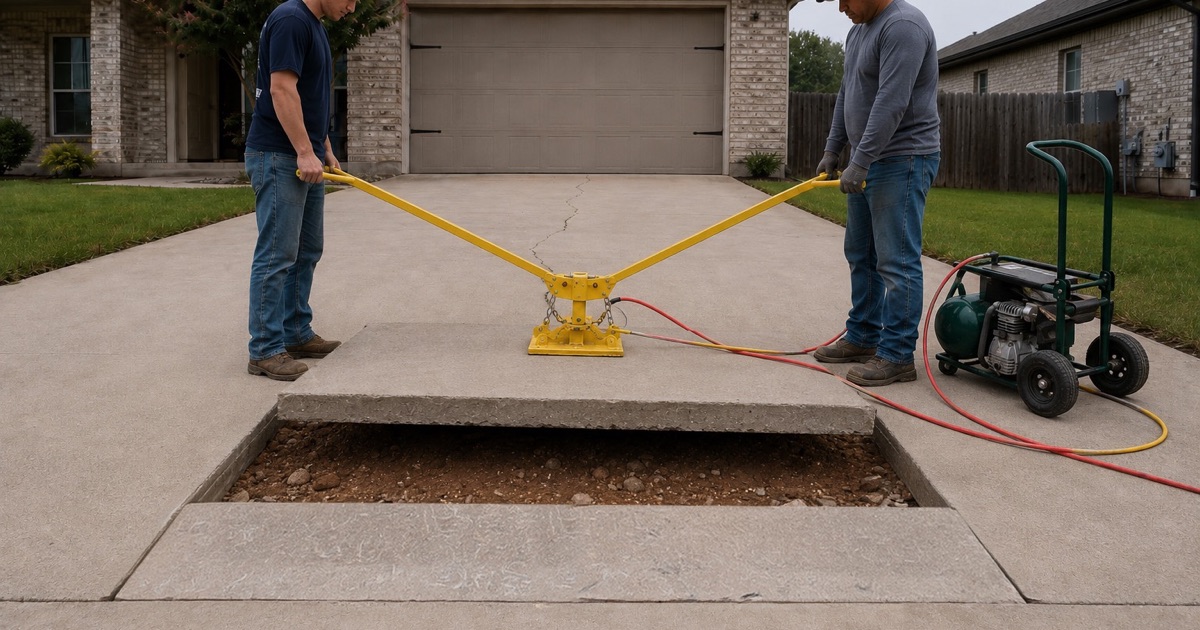
A slab sitting lower than it used to has not shrunk — the material beneath it moved, compacted or washed away, usually along a downspout line, a utility trench or a poorly compacted backfill. The visible drop is the symptom and the cavity is the actual defect. We probe the void through small test holes so the repair is priced against what is really under there rather than against what the surface suggests.
Spalling, Scaling and Surface Loss
Spalling is concrete breaking away in flakes or sheets, and it usually traces back to the finish rather than the mix — water worked into the surface during troweling, or a slab finished before bleed water had left. Once the dense surface layer is gone, the concrete underneath absorbs water and the loss accelerates. We resurface where the structure is sound and replace where it is not, and we say which is which in writing.
Residential Concrete Repair
Driveway Repair and Partial-Depth Patching
A driveway rarely fails all at once; it fails at the apron, along an edge, or in one panel that lost its base. Partial-depth repair saws out the damaged section to a clean edge, keys into sound concrete and replaces it, which costs a fraction of tearing out the drive. Where more than roughly a third of the panels have gone, we say so and quote replacement instead of selling you a patchwork that never quite matches.
Patio, Walkway and Pool Deck Repair
Patios and pool decks fail differently from driveways because the loads are light and the exposure is severe. Here it is usually surface scaling, an opened control joint, or a section that settled toward the pool shell. We reseal joints with flexible sealant over backer rod, lift settled sections rather than replacing them, and keep pool deck repairs light in color and textured so the finished surface is still usable barefoot in August.
Garage Approach and Isolation Joint Resealing
The gap where the driveway meets the garage slab is an isolation joint doing exactly what it was built to do — the drive and the house foundation are separate structures and move independently. The failure is not the gap; it is the gap left open, letting water into the subgrade until the drive settles for real. We clean it out and reseal it with a flexible sealant on backer rod rather than packing it with rigid material that cracks straight back out.
Commercial Concrete Repair
Parking Lot and Drive Aisle Repair
Commercial lots fail in patches long before they fail as a whole, and the patches concentrate where trucks turn, brake and load. We phase repair so the lot keeps working through it, replacing full panels where the base has gone and using partial-depth repair where only the surface has, with dowel baskets across joints that carry traffic. Doing it in stages costs less than a single shutdown and keeps your tenants trading.
Loading Dock, Equipment and Housekeeping Pad Repair
Dock aprons and equipment pads take point loads and vibration that ordinary flatwork never sees, so they fail at edges and anchor points first. We rebuild spalled dock edges, reset loose anchors, and pour replacement generator, transformer and housekeeping pads to the equipment manufacturer’s drawing so the installer is not chipping concrete on delivery day. Level tolerance on those pads is part of the scope, not an afterthought.
Accessible Route, Curb Ramp and Detectable Warning Repair
The accessible route through a lot is the first thing an inspector looks at and the first thing a repair can quietly break. A patch that leaves a lip, a running slope pushed out of tolerance, or a detectable warning surface with damaged truncated domes all fail. We build curb ramp and route repairs to PROWAG and the Texas Accessibility Standards and check finished slopes with a level before we call it done.
Repair Methods, and When Each One Is Right
Partial-Depth and Full-Depth Repair
Partial-depth repair removes and replaces the damaged upper portion of a slab where the base below is still sound, and it is the cheaper answer whenever it genuinely applies. Full-depth repair takes the panel out to the subgrade, fixes what is under it, and pours back with the reinforcing tied in. The choice is decided by what the probe finds underneath, not by what the surface looks like, and we show you the finding.
Polyurethane Foam Injection and Slabjacking
Where a sound slab has simply lost support, polyurethane foam injection lifts it back through small ports and cures within minutes, so the surface is usually back in service the same day. Older mudjacking pumps a much heavier slurry through larger holes, which adds weight to ground that already failed to carry what was there. For most residential slabjacking here, foam is the better trade and we price it against replacement so you can see the gap.
Diamond Grinding, Joint Resealing and Overlays
Not every defect needs concrete. Diamond grinding takes an offset lip between sidewalk panels down to a flush transition in an afternoon and removes a trip hazard for a fraction of replacement. Joint resealing keeps water out of the subgrade and is the cheapest preventive work there is. A microtopping or overlay resurfaces a worn but structurally sound slab — and is wasted money on a broken one, which is why we check the base first.
Our Step-by-Step Concrete Repair Process
Step 1: Diagnose Before Quoting
We walk the slab, map the cracks, check falls with a level and probe for voids through small test holes. The output is a written finding that says what failed and why, because a number with no diagnosis behind it is a guess dressed up as a quote.
Step 2: Locate Tendons and Utilities
Before any saw comes out, we scan for post-tensioning tendons and locate utilities in the work area. On a slab built here since the 1990s that step is not optional, and it is the difference between a routine repair and a structural incident.
Step 3: Fix the Cause, Not the Symptom
If a void caused the settlement, the void gets filled and the drainage that made it gets addressed. If rigid bearing on rock caused the crack, the repair gets a joint where the slab wants to move. Skipping this step is why repairs come back.
Step 4: Repair, Match and Joint
We saw clean edges rather than breaking ragged ones, key into sound concrete, tie reinforcing in, and place joints where the slab will actually move. We tell you honestly that new concrete will not match old on day one, and we plan the joint line so the transition reads as intentional.
Step 5: Cure, Seal and Walk It With You
We apply a curing compound so the repair gains strength instead of drying out, reseal joints once the concrete has moved through its early shrinkage, and walk the finished work with you. You get the dates for foot traffic, vehicles and sealing in writing rather than as a verbal guess.
- 20+ Years Pouring Concrete
- Registered & Insured
- We Pour Our Own Jobs