
Cedar Park Elite Concrete has been placing stamped concrete in Cedar Park, TX for more than 20 years, serving surrounding cities including Brushy Creek, Leander, Hudson Bend, Round Rock and Wells Branch. Stamped work is ordinary structural concrete that gets textured and colored while it is still plastic, so what you end up with is a slab first and a finish second.
That order matters more than the pattern catalog does. A stamped patio sitting on a badly prepared subgrade is a stamped patio that cracks through the pattern, and no amount of color hides a crack running across a flagstone joint that was never meant to be there. We build the slab to last and treat the impression as the last twenty minutes of a much longer job.
The other thing worth knowing before you choose stamped is that it is a timing job. Pouring, coloring, stamping and jointing all have to happen inside one window that the concrete decides, not the crew, and the window is shorter in July than in March. That is why we pour our own stamped work rather than handing it to whoever is available that week.
Color: How Stamped Concrete Actually Gets Its Look
Integral Color Through the Whole Slab
Integral color is mixed into the concrete at the plant, so the color runs all the way through rather than sitting on top. It is the most forgiving choice over time: a chip or a scuff exposes more of the same color instead of gray underneath. It is also the harder one to change your mind about, because the decision is made when the truck is batched.
Color Hardener and Release Agent for Depth
Color hardener is broadcast onto the fresh surface and worked in, which both colors and densifies the wearing surface. A release agent goes on before the stamps so the mats lift cleanly, and because it is usually a contrasting shade it also lands in the low spots and produces the variation that keeps stamped work from reading flat.
The combination is what gives a good stamped patio its depth. Used badly, the same two products give you the uniform orange patio everyone recognizes, which is why we put a sample down rather than showing you a photograph of somebody else’s slab.
Acid Stain and Water-Based Stain on Existing Concrete
Where the concrete is already down and sound, staining is often the better route than tearing it out. Acid stain reacts with the slab and gives mottled, variegated results that are genuinely unrepeatable; water-based stain is more predictable and comes in colors acid cannot reach. Neither hides a bad surface, and we will say when an overlay or a microtopping is the honest starting point instead.
Our Step-by-Step Stamped Concrete Process
Step One: Subgrade, Forms and Reinforcement
We start below the concrete. Subgrade compaction, uniform bearing and drainage away from the house get sorted before any form goes up, and reinforcement is set on chairs at height. Fiber mesh helps with shrinkage in the surface where the pattern lives, which matters more here than on a broom finish slab.
Step Two: The Pour and the Working Window
Slump gets controlled at the truck, because water added on site both weakens the slab and wrecks the timing. Summer pours are scheduled off the temperature of the concrete rather than the forecast, since the state highway spec starts the discharge clock once the mix itself reaches ninety degrees. In practice that means early starts and a short haul on a stamped job.
Step Three: Coloring and Stamping the Pattern
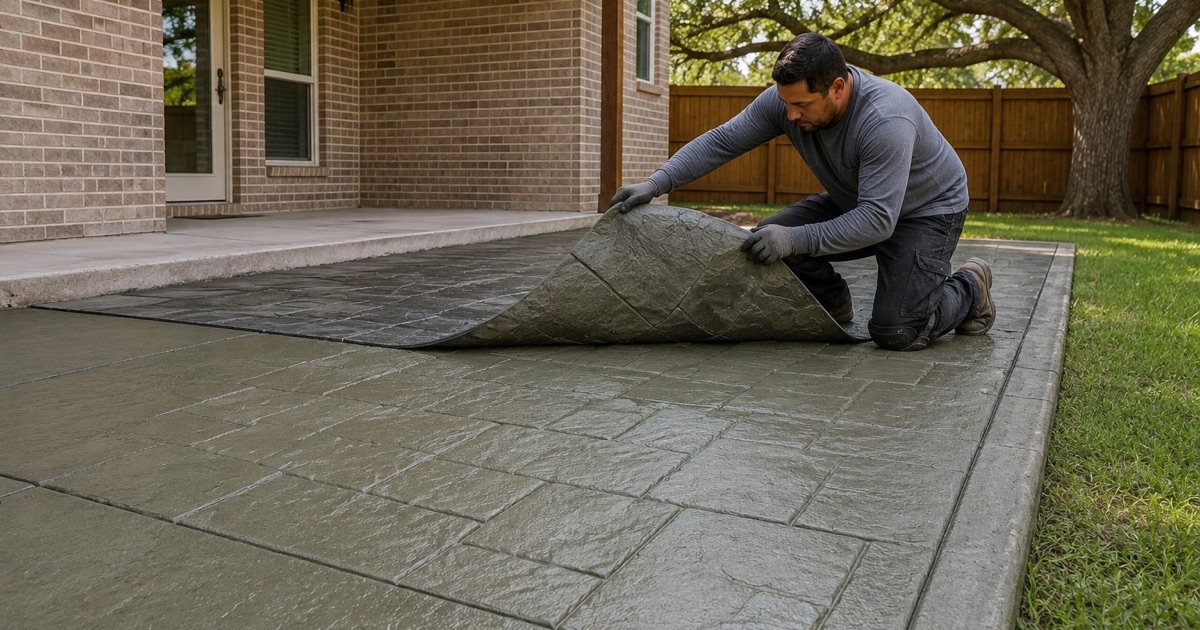
Once the surface has taken its initial set, color hardener and release go down and the mats go on in sequence. Stamping is done in order and to a layout planned in advance, because a pattern that starts to wander cannot be walked back on a slab that is stiffening. Detail work at the edges, borders and against the house is hand-tooled.
Step Four: Washing, Jointing and Curing
The release gets washed off after the slab has hardened enough to take it, and how much comes off is a color decision as much as a cleaning one. Sawcut control joints go in on a layout that follows the pattern rather than cutting across it where possible, and a curing compound goes on to hold moisture in the slab through the days that set its final strength.
Where Stamped Concrete Belongs, and Where It Does Not
Patios, Pool Decks and Walkways
Patios are where stamped work earns its keep, because the surface is decorative, foot-traffic only and directly in view. On a pool deck the same is true with one caveat: the texture has to give grip when wet, which rules out some of the smoother slate and ashlar patterns unless the sealer carries a grit additive.
Driveways and Vehicle Areas
Stamped driveways work, and they ask more of the installation. The slab has to be built for vehicle loads first and decorated second, and the finish sees tires turning, hot exhaust and dropped oil rather than patio furniture. We will build one and we will tell you honestly that it needs resealing on a shorter cycle than a patio does.
Borders, Bands and Restraint
Some of the best stamped work here is mostly not stamped. A broom finish or an exposed aggregate field with a stamped border reads as a deliberate design, wears better in traffic, and costs less than stamping the whole area. Where a client wants pattern everywhere we will do it, but the suggestion is worth making.
Sealing and Living With Stamped Concrete in Central Texas
Sun, Color and the Reseal Cycle
Sun is what ages stamped concrete here, not cold. Color fades slowest with integral color and fastest with a topical treatment left unsealed, and the sealer is the sacrificial layer that takes the ultraviolet instead of the surface. We tell you the reseal interval for the product we actually used and put it in writing rather than leaving it as a thing you find out later.
A penetrating sealer and a film-forming sealer are different decisions. Film gives the wet look people usually want on stamped work and needs more upkeep; penetrating sealers change the appearance less and last longer between coats.
Slip Resistance Around Water
Any sealed decorative surface gets slicker wet than a bare broom finish does. On pool decks and shaded walks we add a grit to the sealer as standard, and we would rather have that conversation at quoting time than after somebody has gone over on a wet deck.
Repairs, Joint Resealing and Matching Years Later
Stamped concrete can be repaired, and matching a five-year-old surface exactly is not realistic — the original was colored in one batch and the sun has been working on it since. What we can do is repair the structure properly, reseal the joints, and blend the finish so the repair reads as part of the slab rather than as a patch.
- 20+ Years Pouring Concrete
- Registered & Insured
- We Pour Our Own Jobs