
Cedar Park Elite Concrete pours concrete driveways in Cedar Park, TX and has done for more than 20 years, serving surrounding cities including Brushy Creek, Leander, Hudson Bend, Round Rock and Wells Branch. A driveway here is really two pieces of work with two different rule sets: the slab on your property, and the approach that crosses into public right-of-way at the street.
That split is worth understanding before you take quotes, because it is where most of the surprises live. The private portion is straightforward and, in this city, permit exempt. The approach is inspected before any concrete goes down, and a contractor who has not planned for that either delays your job or pours without the inspection and hopes nobody asks.
The other thing that moves a driveway price is what the slab will sit on. We find out what your subgrade actually is before we price the job, because the ground on this side of the county changes from deep clay to rock close enough to the surface that the excavation becomes the job rather than a line item inside it.
What Goes Into a Concrete Driveway That Lasts
Slab Thickness, Compressive Strength and the Mix We Order
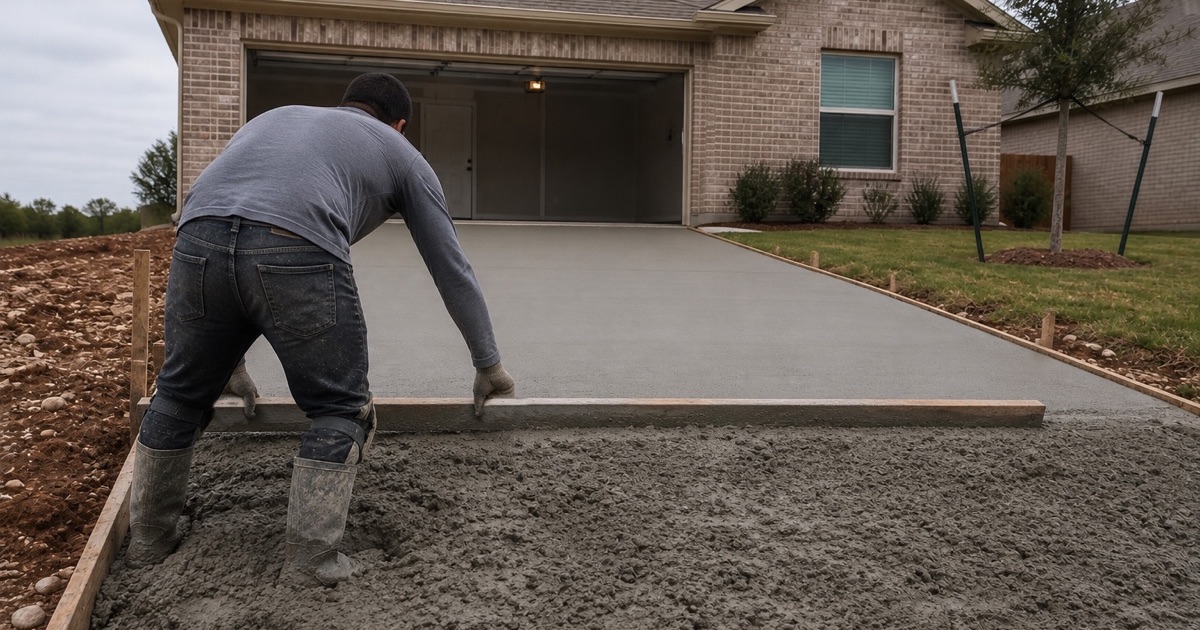
We set thickness from what will actually park on the slab. A driveway that sees two passenger cars and one that takes a loaded RV, a work truck or a delivery vehicle are not the same pour, and building both the same way means one of them is either overpriced or under-built. Compressive strength, air entrainment and the water-cement ratio get specified the same way — from the job, not from habit.
We also plan the delivery. Slump gets checked at the truck rather than adjusted with a hose on the ground, and where access is tight we price a concrete pump truck honestly instead of discovering the problem on pour day. A short pour that triggers a ready-mix short load fee is cheaper to know about in advance.
Welded Wire Reinforcement, Fiber Mesh and Rebar Chairs
Reinforcement only works where it sits. Welded wire reinforcement dragged along the bottom of a slab does approximately nothing, so we set it on rebar chairs at the height it was specified for and keep it there through the pour. Fiber mesh has its place for shrinkage control and is not a substitute for steel where the slab needs structural capacity.
Subgrade Compaction, Flexible Base and Limestone Rock Excavation
Under the concrete we want uniform bearing, which is a different goal from hard bearing. A slab supported on rock at one end and loose fill at the other cracks at the transition no matter how good the mix was. Where indurated limestone comes up close to the surface, limestone rock excavation is the honest answer rather than filling over it and hoping. Where the clay is deep, subgrade compaction and a properly placed flexible base do the work instead.
Caliche shows up as a base material in a lot of older work around here. It behaves well compacted and badly when it is not, and telling the difference is part of what we are looking at when we probe the site.
Driveway Approaches and the Public Right-of-Way
The Phase One Pre-Pour Inspection We Schedule and Wait For
Because the approach crosses into public right-of-way, Cedar Park requires a phase one inspection of the line, grade, forms, reinforcing steel and subgrade before any concrete goes down. We schedule that inspection and we wait for it. That is the whole practice: the forms sit until the city has looked at them.
It is a scheduling cost, not a technical one, and the way it gets skipped is by treating it as optional. An approach poured without the inspection is a liability that sits in your right-of-way indefinitely, and it is your frontage rather than ours when it comes up later.
Building to RD-02 or RD-03 Where No Plain Driveway Detail Exists
Cedar Park publishes no plain driveway detail at all, so we build the crossing to RD-02 or RD-03 as drawn, both of which show a shared use path. Working to a published detail rather than an interpretation of one is what makes the inspection a formality instead of a negotiation.
We work from the transportation criteria manual Cedar Park adopted in June 2026, not the City of Austin manual it replaced. The details changed, and a crew still building from the old book is building to a standard the inspector no longer holds.
The Street Cut Moratorium and What You Cannot Open
If your project needs the pavement opened rather than just the approach rebuilt, the street may be inside the city moratorium, which runs seven years on a collector or arterial and five on a residential street. We tell you that before you plan around a cut rather than after the application comes back.
Jointing, Finishing and Curing a Driveway Slab
Control Joints, Isolation Joints and Where the Slab Will Crack
Concrete cracks; jointing decides where. We lay out sawcut control joints on a spacing that suits the slab and cut them in the window where they will actually relieve the stress, and we isolate the slab from the garage, the house and any fixed structure with proper isolation joints so the two are free to move separately. An expansion joint goes where movement has to be accommodated rather than merely directed.
Broom Finish, Exposed Aggregate and Other Surface Options
A broom finish is the default on a driveway for good reason — it is durable, it grips when wet, and it hides the ordinary marks a driveway collects. Where you want something else, exposed aggregate and a salt finish both hold up outdoors, and integral color survives sun better than a topical treatment does. We will tell you which options look good in a brochure and wear badly on a south-facing slope.
Curing Compound, Sealing and the Hot-Weather Pour
Curing is where a good pour gets thrown away. We use a curing compound and we protect the slab through the first days rather than leaving it to the weather. Summer pours get planned around the temperature of the concrete rather than the air, because the state highway spec starts the discharge clock once the mix itself reaches ninety degrees.
A penetrating sealer is worth putting on a driveway and worth renewing, and we will tell you when. What we will not do is sell a sealer as a fix for a slab that was cured badly in the first place.
Permits, Impervious Cover and What We Check Before Quoting
Residential Driveways Are Permit Exempt Here
We tell you up front that Cedar Park leaves residential driveways and sidewalks permit exempt, instead of billing you for a permit the city does not require. It is a small thing that says a lot about a quote, because a line item for a permit that does not exist is not an oversight.
Impervious Cover Over the Edwards Aquifer
Before we quote new flatwork we check whether your lot sits over the Edwards Aquifer contributing or recharge zone, because state approval has to come before the city will issue a site development permit. We also measure the impervious cover you already have before adding to it, since the state caps a single family lot over the aquifer at twenty percent and counts rooftops, driveways, concrete pads, sheds and sidewalks toward it.
That measurement is what decides whether the driveway you want is the driveway you can have. Finding out at quoting time costs an hour; finding out later costs a design.
Credentials You Can Actually Verify in Texas
Texas issues no state license for a concrete contractor, so a contractor claiming to be state licensed is describing something that does not exist. What can be checked is city registration and the fiscal security the right-of-way ordinance requires, and ours are current. We would rather you verify that than take our word for it.
Twenty plus years in, we still pour our own jobs rather than handing them to whoever is available that week. The crew that quotes your driveway is the crew that finishes it.
- 20+ Years Pouring Concrete
- Registered & Insured
- We Pour Our Own Jobs