
Cedar Park Elite Concrete builds concrete pool decks in Cedar Park, TX and has for more than 20 years, serving surrounding cities including Brushy Creek, Leander, Hudson Bend, Round Rock and Wells Branch. A pool deck answers to a harder set of conditions than any other flatwork on a property: bare feet, standing water, pool chemistry and full August sun, all on the same surface.
Most of the decisions that matter are therefore comfort and safety decisions rather than structural ones. How hot the surface gets, how it behaves wet, and how it is jointed against the pool are the three things owners actually live with, and all three are chosen at quoting time. None of them are expensive to get right at the start, and all of them are expensive to change once the concrete is down and the pool is full.
The structural half still has to be right, and it has one rule that is specific to pools: the deck must never load the shell. Everything else follows from that. A pool shell is a rigid structure sitting in ground that moves, and a deck poured hard against it becomes a lever working on the bond beam every season.
Building a Deck the Pool Can Live With
Jointing at the Coping
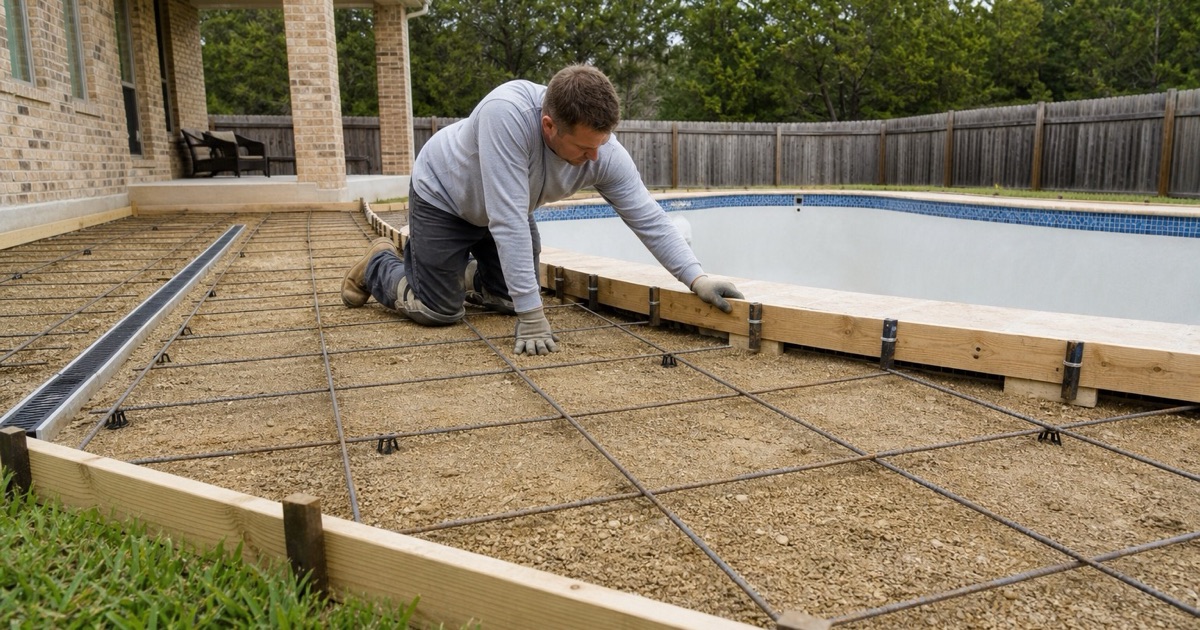
The deck gets an expansion joint where it meets the coping, sized and detailed so the slab can move without bearing on the bond beam. This is the single most consequential detail on the job. A deck poured tight to the coping pushes tile loose and cracks the beam as the ground works through its wet and dry cycle.
That joint is also maintenance rather than a one-time item. The sealant in it has a life, and replacing it every few years is far cheaper than the repair it prevents. We show you where it runs and what it looks like when it is due, so it gets renewed on a schedule rather than after the tile has started coming loose.
Drainage Away From the Water
A deck should shed water away from the pool, not into it, and away from the house at the same time. Where those two directions conflict, a deck drain along the low line resolves it. We set the falls before forming and check them with water rather than by eye, because a deck that ponds is both a slip problem and a staining problem.
Subgrade, Reinforcement and the Ground Around a Pool
Ground around a pool has been excavated, backfilled and worked, so it is rarely the undisturbed soil the rest of the yard sits on. Compaction of that backfill is the thing that decides whether the deck settles in its first two years, and we treat it as its own line of work rather than as site cleanup.
Surfaces Built for Bare Feet
Keeping the Surface Cooler
Light colors reflect more heat than dark ones, so a pale integral color or a light broadcast finish is meaningfully more comfortable in high summer. Texture helps too, by reducing how much of the foot is actually touching concrete at once. We will tell you plainly that no concrete stays cool in full sun, and that the difference between a good choice and a bad one here is still worth having.
Texture and Slip Resistance
Grip is designed in, not hoped for. We keep genuine texture in the finish around water and add a grit to the sealer as standard, and we will steer you off the smoothest patterns for a deck no matter how well they photograph. A broom finish, a salt finish or a light exposed aggregate all give surfaces that behave when wet.
Shaded sections deserve extra attention, because a north-facing strip under a tree stays damp long enough to grow a film that is slicker than anything the concrete does on its own. Those strips are also where people walk fastest, between the house and the water, so the surface there is doing more work than its size suggests.
Color, Stain and Overlays
Integral color, acid stain and water-based stain all work on a deck, with the caveat that darker is hotter. Where an existing deck is sound but tired, an overlay or a microtopping is often the better value than replacement — a new surface, new texture and new color on the slab that is already there.
Sealing, Chemistry and Keeping It That Way
Sealer Choice Around a Pool
A penetrating sealer changes the look least and holds up well against splash-out. A film-forming sealer gives the richer, wet appearance and needs recoating more often, and around water it needs the grit additive without exception. We name the product and the reseal interval in the quote rather than leaving it vague.
Saltwater Systems and Surface Scaling
Salt systems are common here and they are harder on unsealed concrete than a chlorine pool is, showing up as surface scaling along the splash line. Keeping the deck sealed and keeping water moving off the coping edge rather than standing on it deals with both. Scaling shows first as a chalky patch along the splash line and then as actual surface loss, and by the time it is obvious the sealer has been gone a while.
Repairs, Resealing and What We Come Back For
Decks age at the joints and at the splash line first. Cleaning and resealing the joints, renewing the sealer and addressing any lip at a joint before it becomes a trip hazard is most of what a deck ever needs, and it is worth doing on a schedule instead of after something has failed.
Where a deck has moved rather than merely weathered, we will say so rather than selling a resurface over a slab that will crack it within the year. Lifting the settled section or repairing the structure comes first and the new surface goes on afterward. Done in the other order, you have bought a good-looking deck for about a season.
- 20+ Years Pouring Concrete
- Registered & Insured
- We Pour Our Own Jobs